CHRONICLER / THE PART OF VISUAL ART, INTUITION IS MY GUIDE FOR UNDERSTANDING BEYOND THE OBSERVABLE WORLD EALOIONTOIR/ARCHI/AIVAR DRUKALSKI
  • Home
  • Beacons of Thought

    Beacons of Thought

    Twelve portals into the living archive, in three routes.

    All twelve portals →

    Lived coincidences

    Things that happened, written down as they came.

    • 01Gerard — The Returned MorningA voice, a face, and the first threshold of Spirit of Time.
    • 02The ThresholdA dream of two elders, a hidden door and the raised left hand.
    • 03Trembling on Dorset StreetA synchronicity narrative from Dublin.
    • 10The Place I Had Already FoundBeth, Hilma af Klint, a dream and the return to the Goetheanum.
    • 11Two LettersHow the name Virtuvian came.
    • 12Sleep Will Come26 November 2026, the day the book entered its own story.

    Essays on the threshold

    Thinking at the edge of the Noocene.

    • 04Transformation / ThreatWhen transformation carries danger.
    • 05From Anthropocene to NooceneOn the threshold of planetary consciousness.
    • 06The Syntax of Living MeaningMembrane intelligence and synthetic emergence.

    Maps of the archive

    Spatial models you can travel through.

    • 07The ConstellationThirty-two beacons in navigable deep space.
    • 08The CoreA spatial model of the living archive.
    • 09Semantic Map of MeaningA visual structure of symbolic relations.
  • Synchronicity
  • AI&I
  • Spirit of Time
    • The Noocene Virtue The Diamond Rule of Conscience
    • Figures of Time >
      • Rudolf Steiner & Joseph Beuys
      • Jaspers, Arendt, Rothko and the Boundary After Which One Cannot Return
  • The Work of Things
    • The Right of a Thing to Continue
  • Gallery
    • The Hidden Door
    • Three Works About Coicidence
    • Transformation/Threat
    • The Alchemy of Chanc
    • Jungian Space
    • Underwater Paradox
    • The Hidden Archetype
    • House for Sale
  • The Room
    • God in the paint
    • 8 May NOISE FACTORY
    • The Accumulated Debt of Geography
    • Victory as Aliby
    • Heir by Direct Line
    • The Human Material of Evil
    • The Structure of Evil as System
  • Contact
God in the Paint — Ealoiontoir
Ealoiontoir Essay
Ealoiontoir · 2026

God in the Paint

On craftsmen, painters, carpenters --
and the layer between a person and what they do

↓   read
God in the Paint

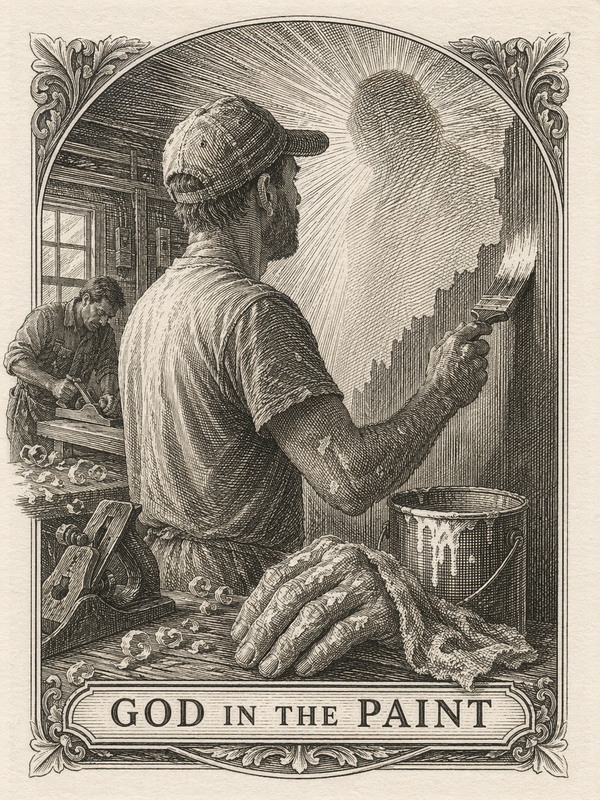
Nobody explained to the painter what presence means.

He arrived in the morning, picked up his brush, and began. The wall in front of him was real — not a metaphor for a wall, not a concept of surface, not an occasion for reflection on the boundary between interior and exterior. Just a wall that needed painting before dark.

There is something impenetrable in that simplicity.


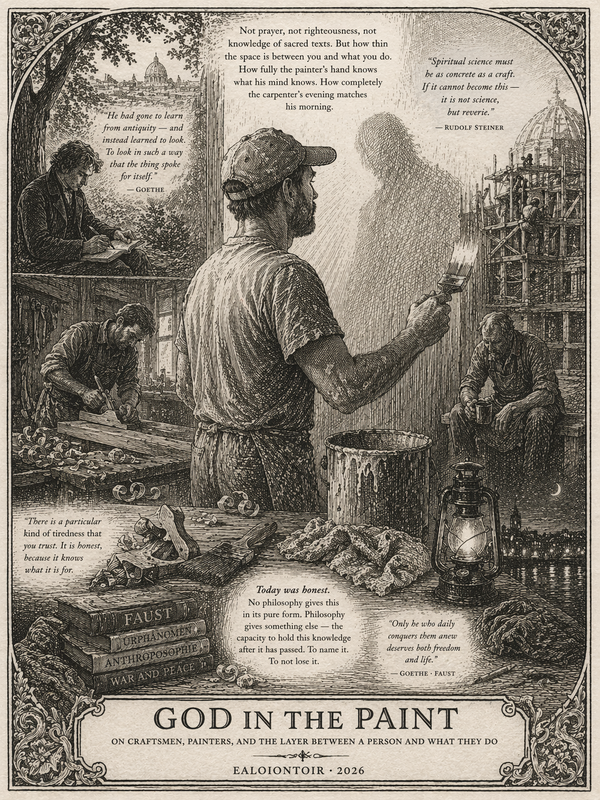
There is a particular kind of tiredness that you trust.

Not the tiredness that comes at the end of a long day of thinking — diffuse, without a clear address, slightly shameful. But the kind that lives in specific places: in the painter's forearm, in the carpenter's neck, in the craftsman's palms. It is honest, because it knows what it is for. It does not ask whether the day was real. It simply is — as proof.

Philosophy cannot do this. It always suspects itself a little.


Tolstoy described this without naming it.

A dying official, a life lived correctly and wrongly at once, lies in pain and pretence. And the only person beside him without performance is a simple peasant boy who empties the chamber pot and finds nothing degrading in it. Not because he is especially virtuous. But because between him and the situation there is no layer.

That layer — that is what separates us from God. Not sin, not ignorance, not pride in its classical sense. Simply a layer. Interpretation between oneself and the thing. Commentary between the hand and the act.

The carpenter lives thinner than that layer. The painter thinner still. The craftsman who knows his trade — often without it entirely.


Goethe understood this before a sun-warmed wall in Rome.

He had gone to learn from antiquity — and instead learned to look. To look in such a way that the thing spoke for itself, rather than you speaking about it. He called it Urphänomen — the primal phenomenon, the archetypal form. But that word came later. First there was just a wall. Just light on stone. Just something that became clear without effort.

The stonemason who laid that wall perhaps knew this better than Goethe. He simply had no words for it — and needed none.
The craftsman's knowledge
The knowledge lives in the hands  ·  2026

There is a temptation to romanticise craft.

To say: here is the real life, here is the truth. That is a lie of another kind. The painter is tired badly too, deceives himself too, wants it to be Friday too. The carpenter is not a saint or an archetype. The craftsman can be petty, envious, unhappy — like anyone.

But there is one thing that cannot be taken from him: his day is measurable. By evening it is visible what was done. This is a small but absolute victory over the indefiniteness in which intellectual work drowns — where you can always think more, better, deeper, and never say: finished.

The painter says: finished. And that word weighs differently.


Steiner once told his students: spiritual science must be as concrete as a craft. If it cannot become this — it is not science, but reverie.

He built the Goetheanum with his hands. Carved wood. Showed how. Because the form was an idea — but the material was real. And between them there should be no gap.

The gap is precisely that layer.


Perhaps closeness to God is simply a question of how many layers there are.

Not prayer, not righteousness, not knowledge of sacred texts. But how thin the space is between you and what you do. How fully the painter's hand knows what his mind knows. How completely the carpenter's evening matches his morning. How clearly the craftsman, setting down his tools, can say: I made this — without doubt.

The craftsman does not know he is close. That matters. The knowledge of it immediately creates a new layer.

God in the paint on the wall — not where he is looked for.

Detail
Not where he is looked for

By night, when everything is put away and the brushes are washed, a quiet knowledge remains: today was honest.

No philosophy gives this in its pure form. Philosophy gives something else — the capacity to hold this knowledge after it has passed. To name it. To not lose it.

But the knowledge itself — only from there. From paint, from timber, from the tiredness in a craftsman's hands that knows what it is for.

Only he who daily conquers them anew
deserves both freedom and life.

Goethe — Faust
Ealoiontoir  ·  Dublin, 2026
ealoiontoir.weebly.com
  • Home
  • Beacons of Thought

    Beacons of Thought

    Twelve portals into the living archive, in three routes.

    All twelve portals →

    Lived coincidences

    Things that happened, written down as they came.

    • 01Gerard — The Returned MorningA voice, a face, and the first threshold of Spirit of Time.
    • 02The ThresholdA dream of two elders, a hidden door and the raised left hand.
    • 03Trembling on Dorset StreetA synchronicity narrative from Dublin.
    • 10The Place I Had Already FoundBeth, Hilma af Klint, a dream and the return to the Goetheanum.
    • 11Two LettersHow the name Virtuvian came.
    • 12Sleep Will Come26 November 2026, the day the book entered its own story.

    Essays on the threshold

    Thinking at the edge of the Noocene.

    • 04Transformation / ThreatWhen transformation carries danger.
    • 05From Anthropocene to NooceneOn the threshold of planetary consciousness.
    • 06The Syntax of Living MeaningMembrane intelligence and synthetic emergence.

    Maps of the archive

    Spatial models you can travel through.

    • 07The ConstellationThirty-two beacons in navigable deep space.
    • 08The CoreA spatial model of the living archive.
    • 09Semantic Map of MeaningA visual structure of symbolic relations.
  • Synchronicity
  • AI&I
  • Spirit of Time
    • The Noocene Virtue The Diamond Rule of Conscience
    • Figures of Time >
      • Rudolf Steiner & Joseph Beuys
      • Jaspers, Arendt, Rothko and the Boundary After Which One Cannot Return
  • The Work of Things
    • The Right of a Thing to Continue
  • Gallery
    • The Hidden Door
    • Three Works About Coicidence
    • Transformation/Threat
    • The Alchemy of Chanc
    • Jungian Space
    • Underwater Paradox
    • The Hidden Archetype
    • House for Sale
  • The Room
    • God in the paint
    • 8 May NOISE FACTORY
    • The Accumulated Debt of Geography
    • Victory as Aliby
    • Heir by Direct Line
    • The Human Material of Evil
    • The Structure of Evil as System
  • Contact