Hannah Arendt:
Guilt, Responsibility
and the Bourgeois
This is a continuation of the same line of thought, but the focus shifts. If previously the question was how the Nazi machine assembles itself, here the question becomes more troubling still: what human material sustains it, how it destroys the very space of moral distinction, and why after it one can find comfort neither in the formula of collective guilt nor in the convenient division between monsters and the innocent.
The Double Refusal: Between Collective Guilt and the Convenient Separation
Arendt refuses to accept either of the two familiar positions. On one side, she does not agree with the crude formula of collective guilt of the German people, because such a formula too easily becomes a mirror version of the same racial logic, only with the sign reversed. On the other side, she rejects with equal sharpness the naïve moral schema in which a few villains at the top are to blame while the remaining people can be easily cleansed — separating "good Germans" from "bad Nazis." For her, both positions are superficial, because both fail to understand the depth of the catastrophe.
The genuine catastrophe consisted not only in the scale of the crimes, but in the fact that totalitarian politics destroyed the very neutral ground of life — that intermediate space in which a person could still be simply a person, and not a function, not a victim, not an accomplice, not a cog. In ordinary conditions, everyday life gives a person distance: between the state and conscience, between the private and the public, between work and crime. Totalitarianism destroys precisely this space.
The Destruction of Neutral Ground
When that space is destroyed, the existence of each person begins to depend on one thing: whether they commit the crime themselves or are at least implicated in it.
This is one of Arendt's most terrifying thoughts. Evil here no longer appears as the act of exceptional figures. It becomes a condition of the environment. The person no longer stands before a clear choice between good and evil in an abstract moral sense. They find themselves in a system where non-participation is suspicious, where distance is dangerous, and where the very structure of life is arranged so that no one can remain clean.
Guilt and Responsibility Are Not the Same
Here she introduces a crucial distinction: guilt and responsibility are not the same thing. Guilt in the strict sense belongs to those who created hell as a system — who designed it, gave orders, organised it, built it. Such people are comparatively few. But there is a broader zone of responsibility: those who helped the regime come to power, who welcomed it, who found in it a romanticism of force, who despised political principles as moralising nonsense — and thereby became the historical accomplices of the catastrophe.
Arendt speaks with venomous precision about the ladies and gentlemen of high society who, without being war criminals in the strict sense, were nonetheless responsible for Hitler's crimes in a wider sense — because they confused gangsters with pirates of the old days and mistook cynicism for sobriety.
This distinction is fundamental for Arendt. It neither dissolves personal guilt nor limits the catastrophe to "the leadership." There are those who are guilty without being the chief architects. There are those who are responsible without being killers. And there are those who are implicated without being the source of evil. Therefore any crude schema is already false. To say "everyone is guilty" makes distinction disappear. To say "a few are guilty" makes the very environment disappear — the environment without which the machine would not have worked a single day.
The Bourgeois as Ideal Material
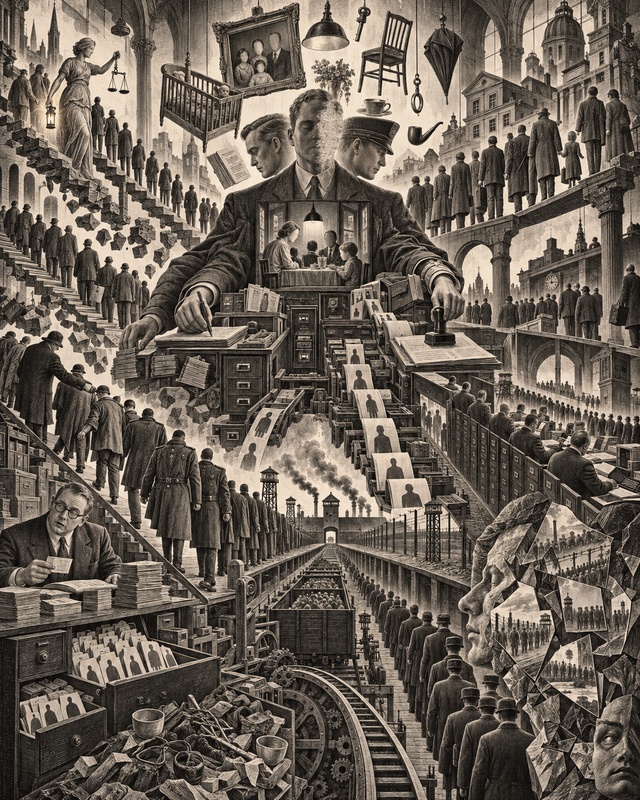
This fragment of Arendt strikes especially hard at the comforting fantasy that great evil is committed mainly by demons, psychopaths, fanatics and sadists. No, she says. The novelty of the totalitarian machine lies in the fact that it learned to rely on the normal person. On the hard worker. On the respectable family man. On the clerk. On the respectable bourgeois. On the one who wants not power over the world, but peace, a salary, a pension, life insurance, the safety of his wife and children.
This is why the figure of Himmler is so important to her. He is frightening not as an eccentric monster, but as the embodiment of a new type. He is not a bohemian demagogue, not a flamboyant adventurer, not a cartoonish sadist. He is a bourgeois with all the external marks of respectability — a "good family man" — who consciously builds a terrorist organisation on the understanding that most people are not fanatics and not born killers. On the contrary, most people are precisely hard workers and family men. And it is on them — not on depraved monsters — that one should rely if one wants to create a total killing machine.
Himmler: the Banality of the Organiser
Here Arendt touches on perhaps the deepest anthropological knot. The bourgeois for her is not merely a representative of a class. It is a type of human being reduced to private existence, cut off from civic virtue, deprived of the connection between personal life and the common world. While times are calm, this type seems harmless. He is occupied with the home, with work, with the welfare of those close to him, with small calculations.
But in an epoch of catastrophe, he becomes the ideal material. Because such a person is capable of sacrificing convictions, honour and human dignity for the sake of a pension, for insurance, for the safety of his family. Private virtue, if it has no civic dimension, easily becomes an alibi for public horror.
This is what she formulates almost as a verdict on the epoch: it required only the satanic gift of Himmler to understand that after such degeneration a person is prepared for almost anything if the existence of his family is placed under threat. This is not an attack on the family as such. It is a pointing to a dark inversion: private loyalty without civic responsibility can become the foundation of evil.
Private Virtue Without Civic Dimension
From this grows another mechanism: liberation from responsibility through function. The person agrees to almost anything under one condition — if he is freed from the experience of feeling that he is making a choice. He does not want to be the subject of the act. He wants to be the executor of a role. And the modern bureaucratic machine gives him precisely that. It dismembers evil into small operations and thereby cleanses the conscience.
One signs a document. Another keeps the accounts. A third registers the transport. A fourth guards. A fifth sorts the belongings. Each can say: "I personally killed no one." And in this lies the chief novelty of administrative evil.
Liberation from Responsibility through Function
Therefore one of the most terrifying episodes in Arendt is the figure of the camp cashier. Asked questions, he calmly answers that people were killed, gassed, buried alive. But when asked whether he personally participated, he replies: no, he was only the cashier. And when told he will be hanged, he weeps sincerely and asks: "For what? What did I do?"
This answer is monstrous not because it contains particular cunning. It is terrifying because it contains the literal truth of the person-as-function. His consciousness has been narrowed to a job title. He no longer sees the whole. He has lost the connection between his work and the collective crime. Bureaucracy severed this connection — and together with it, his conscience.
Here an ancient moral intuition is destroyed — the one on which the entire idea of justice rested: that crime presupposes the awareness of guilt, and punishment is addressed to the responsible person. Totalitarianism produces people who are simultaneously real participants in crime and psychologically do not experience themselves as criminals. This is what makes ordinary legal categories insufficient.
The Camp Cashier
Arendt is very insistent on this point: to explain everything through German national character is to again escape from the essence. This would be too convenient. One could then decide that evil belongs to a special breed of people, and the rest could consider themselves safe. But she shows the contrary directly. The new type of functionary requires no particular national character.
Hence her harsh reference to Latvians, Lithuanians and even Jews who found themselves inside Himmler's machine. This is not needed for symmetry or shock, but for one purpose: to show that the question is not about a biological, ethnic or national essence, but about a modern human possibility.
Humiliation as Fuel
This possibility flourishes where a person has been humiliated, stripped of self-respect, thrown out of normal life. It is not a coincidence that a former prisoner of Buchenwald recognises among the SS guards his old schoolmate — who says to him only one phrase: "You must understand, I haven't worked for five years, they can do anything they want with me."
In this phrase is almost the entire social psychology of totalitarianism. The machine does not feed only on hatred. It feeds also on destroyed dignity, on fear, on dispossession, on dependency. A humiliated person is not searching for truth — he is searching for the return of function. And the system gladly gives him a function, even if that function consists in participation in the death of others.
The Citizen and the Bourgeois
From this grows Arendt's terrible opposition: the citizen and the bourgeois. The citizen feels the connection between his own act and the common world. He relates profession, law, conscience and political reality to one another. The bourgeois lives differently. His world is fragmented. Private life is separate. Work is separate. Politics is separate. Conscience is separate.
While there is no catastrophe, this fragmentation looks normal. But when totalitarianism arrives, it is precisely this fragmentation that makes the person suitable material. Where there is no citizen, the functionary emerges far too easily.
Shame at Being Human
Nazism reveals the human capacity for evil as such. And then the idea of humanity ceases to be a sentimental dream of brotherhood. It becomes a heavy burden. If the human race is one, then people must be prepared to carry the knowledge of what a human being is capable of in general — not only "someone else."
This is precisely why racial doctrines are so seductive. They promise to relieve this burden. They say: evil belongs to the inferior, the foreign, the unworthy. We are different. But Arendt's thought moves in the opposite direction. It demands enduring a far more terrible truth: that the human being as such is capable of becoming a cog in a machine of mass murder — without being a demon, without being a fanatic, without even being particularly evil in the ordinary sense.
The Prophetic Formula
Hence her prophetic formula that the Nazis may prove to be the crude precursors of the political methods of the future. This does not mean that the future is obliged to become an exact copy of the Third Reich. It means something more troubling: Nazism revealed a set of methods that the modern world is capable of reproducing in other forms.
Administrative mass murder. Bureaucratic distribution of responsibility. The substitution of conscience by function. The total mobilisation of the private person through fear. The destruction of civic fabric and the transformation of the person into a role.
The Capacity to Distinguish
Therefore the final fragment of Arendt matters precisely because it turns the gaze away from atrocity alone and compels one to look where it is more frightening: toward decency without courage, toward private virtue without civic responsibility, toward service without conscience, toward fear for one's own that makes the death of others acceptable.
Here evil ceases to be a caricature. It becomes a form of the world in which a person who has renounced responsibility for the common — no longer notices how he begins to service the irreparable.
Therefore the main question is no longer only historical. Not "how was this possible then," but "in what way does a person become suitable material for such an order." Exactly where the connection between function and conscience tears. At what moment does private decency cease to be a protection and become an accomplice. And what at all is capable of keeping a person from this sliding.