CHRONICLER / THE PART OF VISUAL ART, INTUITION IS MY GUIDE FOR UNDERSTANDING BEYOND THE OBSERVABLE WORLD EALOIONTOIR/ARCHI/AIVAR DRUKALSKI
  • Home
  • Beacons of Thought

    Beacons of Thought

    Twelve portals into the living archive, in three routes.

    All twelve portals →

    Lived coincidences

    Things that happened, written down as they came.

    • 01Gerard — The Returned MorningA voice, a face, and the first threshold of Spirit of Time.
    • 02The ThresholdA dream of two elders, a hidden door and the raised left hand.
    • 03Trembling on Dorset StreetA synchronicity narrative from Dublin.
    • 10The Place I Had Already FoundBeth, Hilma af Klint, a dream and the return to the Goetheanum.
    • 11Two LettersHow the name Virtuvian came.
    • 12Sleep Will Come26 November 2026, the day the book entered its own story.

    Essays on the threshold

    Thinking at the edge of the Noocene.

    • 04Transformation / ThreatWhen transformation carries danger.
    • 05From Anthropocene to NooceneOn the threshold of planetary consciousness.
    • 06The Syntax of Living MeaningMembrane intelligence and synthetic emergence.

    Maps of the archive

    Spatial models you can travel through.

    • 07The ConstellationThirty-two beacons in navigable deep space.
    • 08The CoreA spatial model of the living archive.
    • 09Semantic Map of MeaningA visual structure of symbolic relations.
  • Synchronicity
  • AI&I
  • Spirit of Time
    • The Noocene Virtue The Diamond Rule of Conscience
    • Figures of Time >
      • Rudolf Steiner & Joseph Beuys
      • Jaspers, Arendt, Rothko and the Boundary After Which One Cannot Return
  • The Work of Things
    • The Right of a Thing to Continue
  • Gallery
    • The Hidden Door
    • Three Works About Coicidence
    • Transformation/Threat
    • The Alchemy of Chanc
    • Jungian Space
    • Underwater Paradox
    • The Hidden Archetype
    • House for Sale
  • The Room
    • God in the paint
    • 8 May NOISE FACTORY
    • The Accumulated Debt of Geography
    • Victory as Aliby
    • Heir by Direct Line
    • The Human Material of Evil
    • The Structure of Evil as System
  • Contact
The Threshold · Spirit of Time
Закрыть · Esc

Codex . Spirit of Time . From the Series: Synchronicity · Part 1

The Threshold

A dream of two elders, a hidden door, and the raised left hand

Descend
I · The Bar

Alpine Threshold

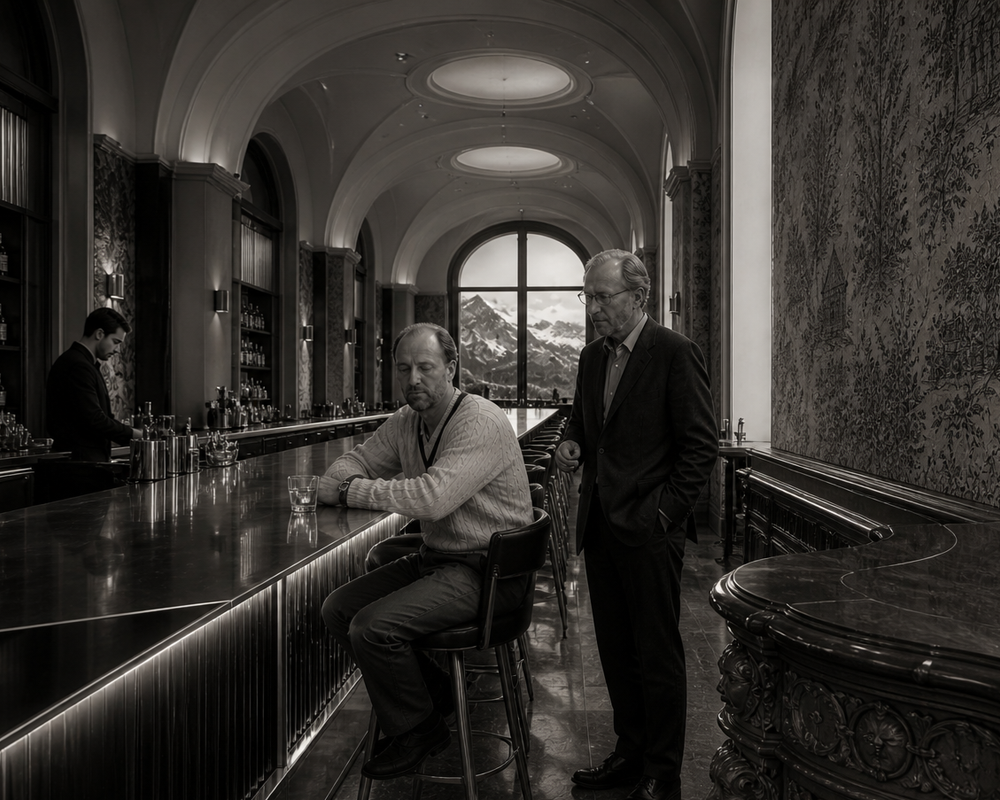
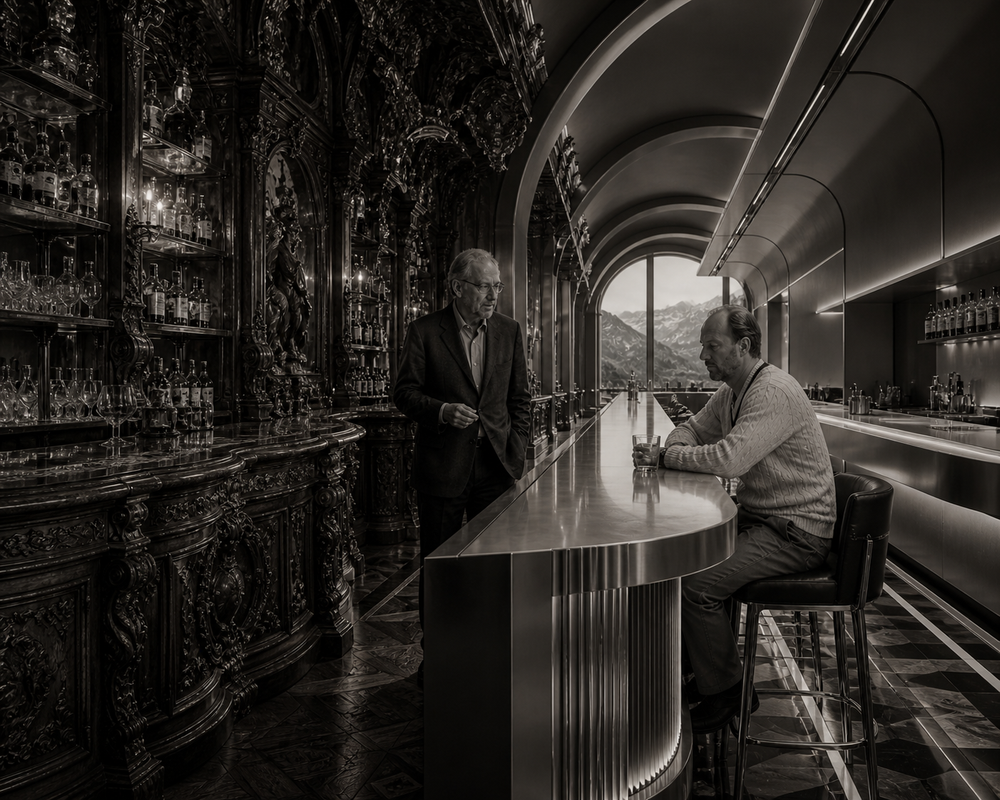
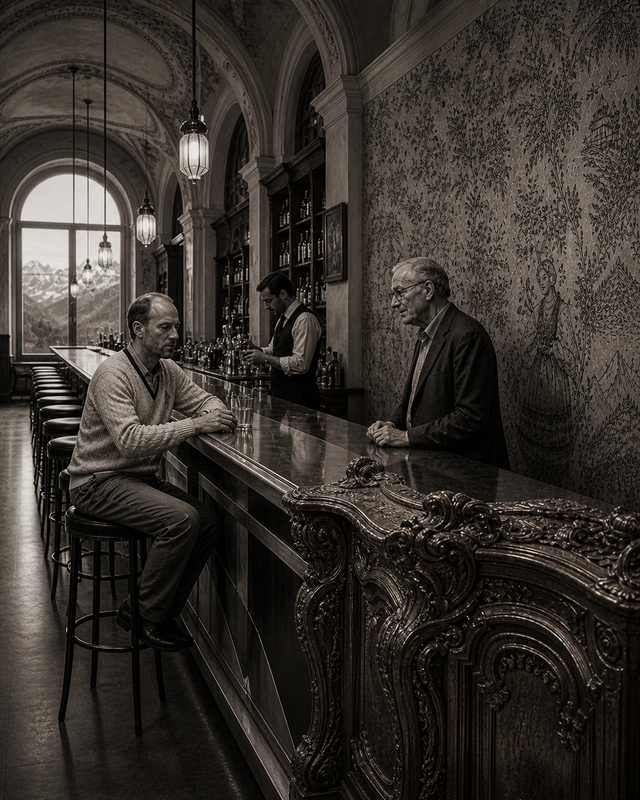
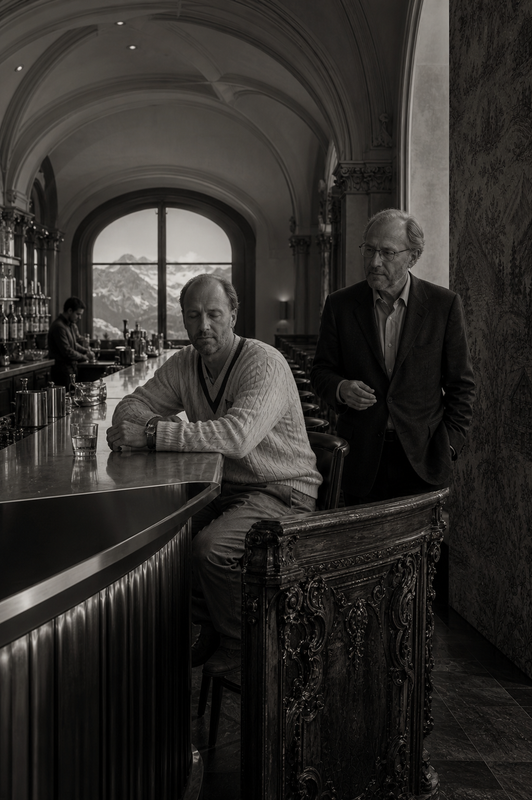
Somewhere in the Alps — though I could not have named it so then, the sensation of the mountains was simply present, like pressure in the air. I was seated at a long counter, on one of those high stools that leave the feet unsupported.

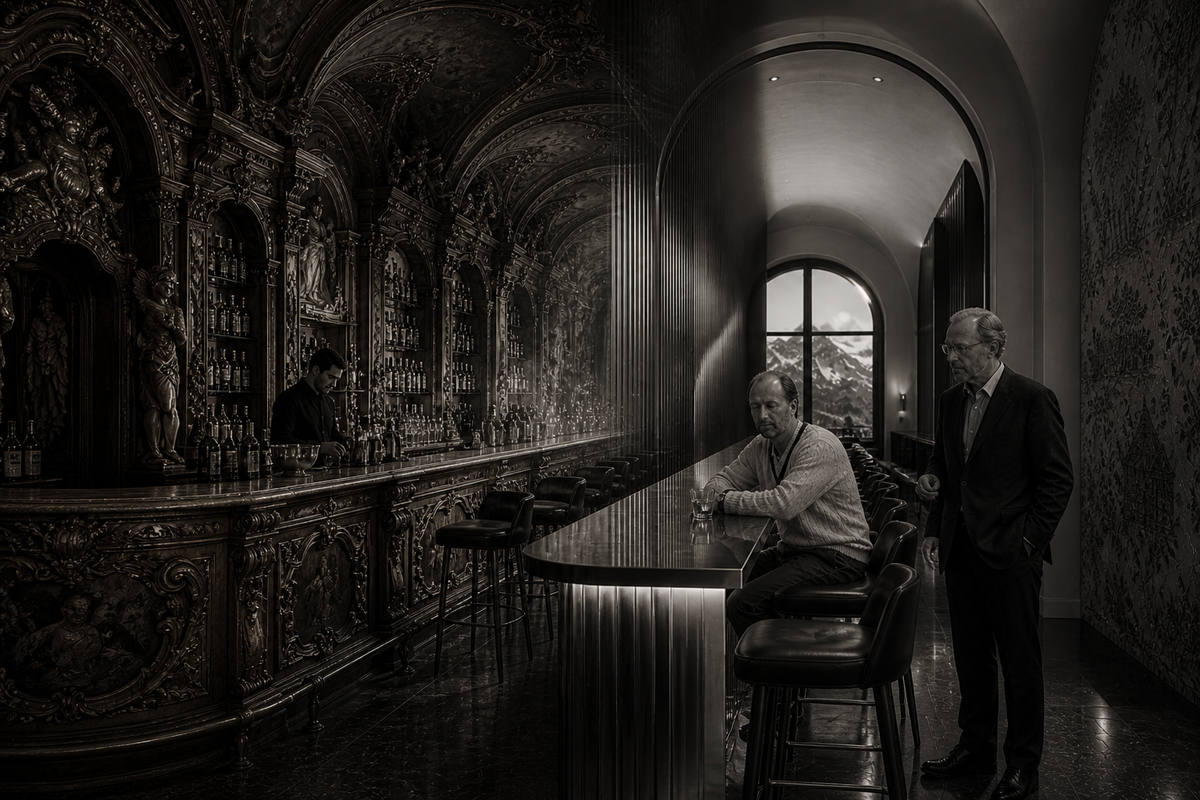
What held my attention was not the room itself but the bar counter: something was happening to its form. At one end it was contemporary, almost Modernist — clean planes and precise angles. Toward the other end it shifted, slowly, as though the wood itself were remembering something older. Baroque. Renaissance. The ornament deepened as the grain changed. It was not two different objects placed side by side. It was one object in the act of transformation.

I watched this metamorphosis as though it were a natural phenomenon — not disturbing, but deeply significant. Time was not sequential here. It was a surface you could run your hand along.
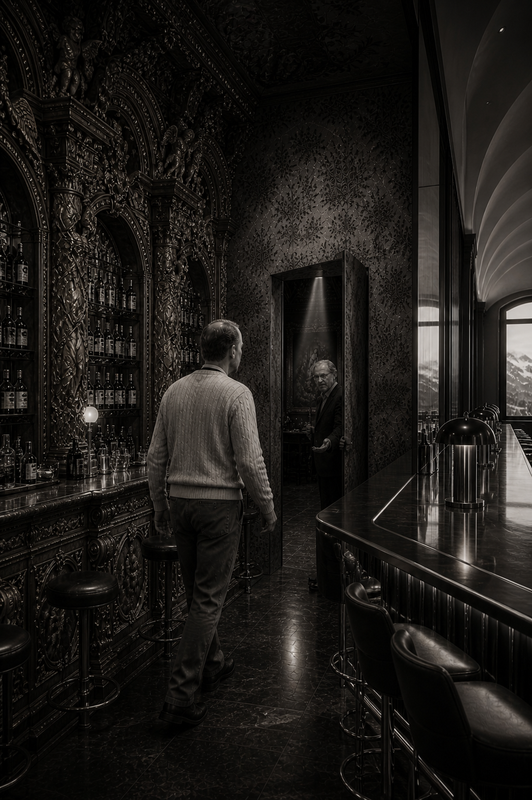
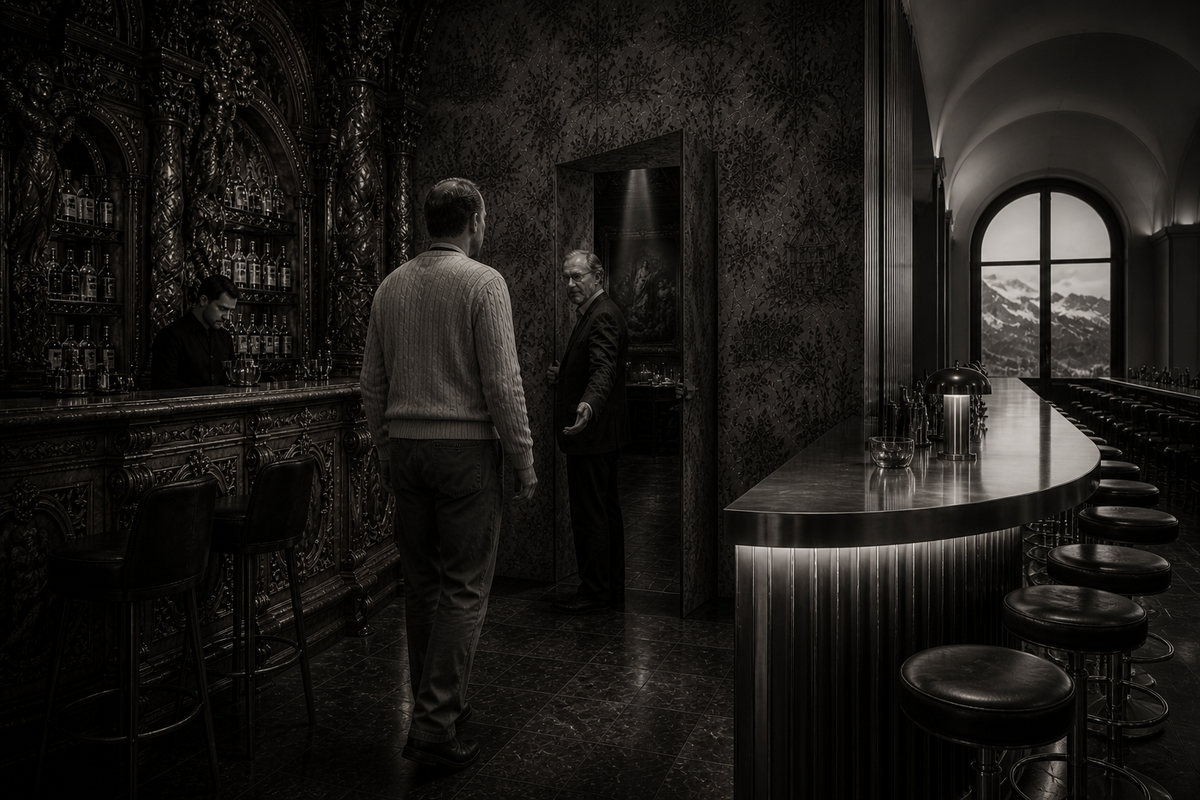
The bar at the threshold The metamorphosis of the counter Alpine atmosphere

The bar where epochs do not oppose one another but flow.

Time was not sequential here. It was a surface you could run your hand along. — I · Alpine Threshold
II · The Encounter

The Invitation

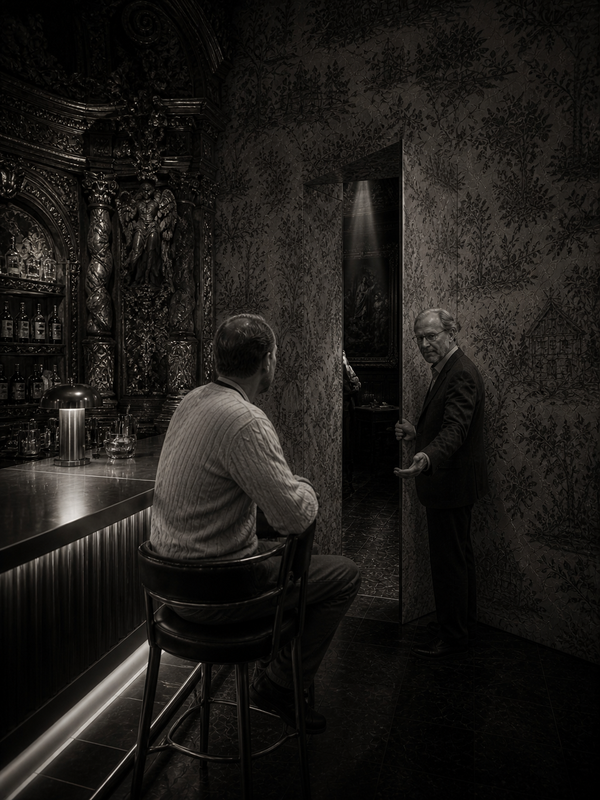
An elderly man approached me. He was grey-haired, composed, unhurried. He suggested we go somewhere together. In the dream I responded almost as I would have in waking life: with mild surprise, a question, a slight hesitation — but no refusal.

His invitation carried no compulsion. It was the kind of proposal that seems to have already been decided elsewhere, requiring only acknowledgment. Something in his bearing was familiar — not as a person I had met, but as a figure I had always been approaching. I said yes.

I would not recognise the face until later. Only after the path had developed — after Bollingen, the Red Book, the letters and the lectures — did I understand who the figure resembled. But then, in the dream, I simply rose from the stool and followed.

The grey-haired elder
Turning from the counter Following into the unknown

A figure known before knowing. The psychopomp arrives without announcement.

III · The Threshold

The Hidden Door

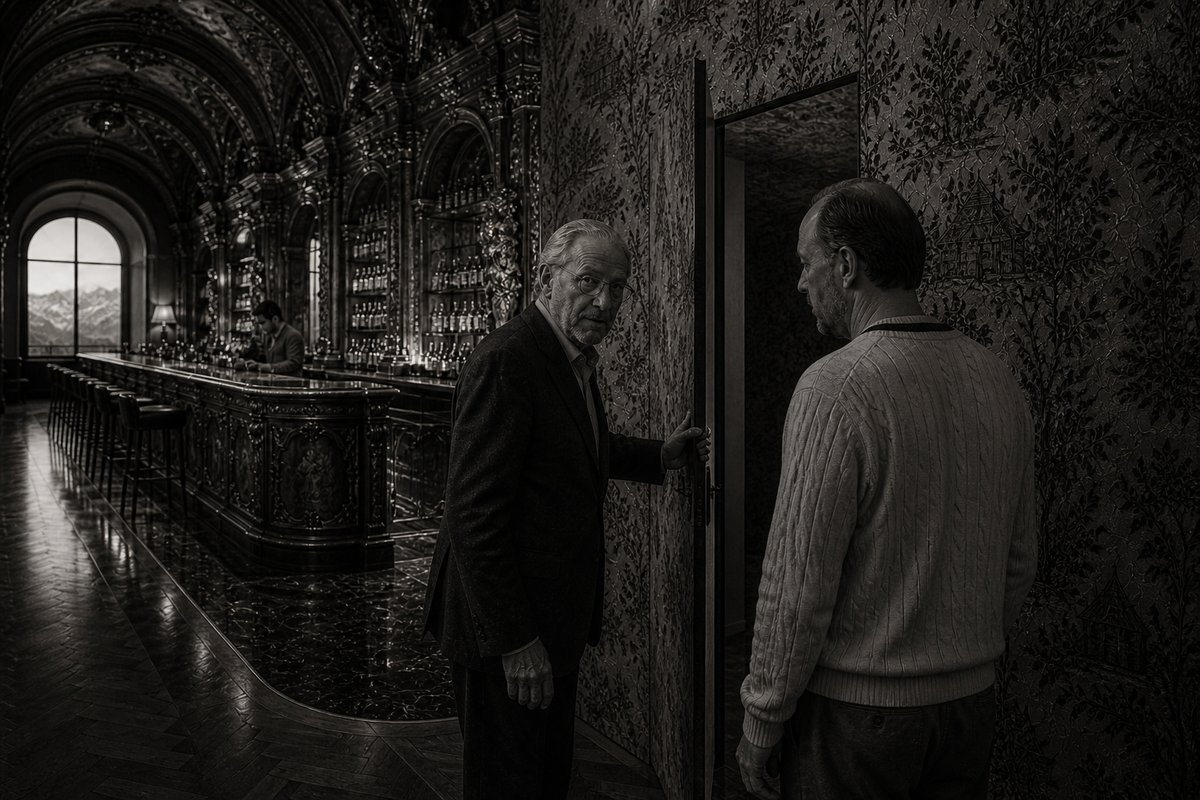
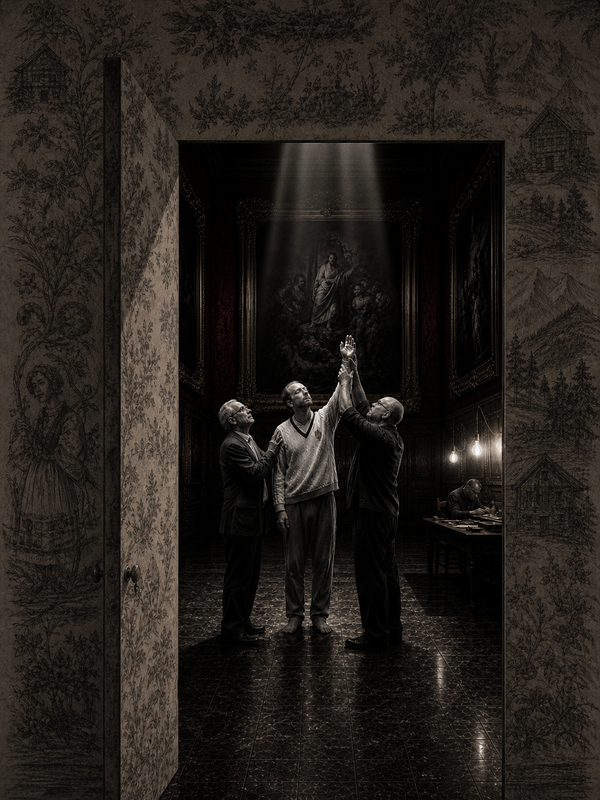
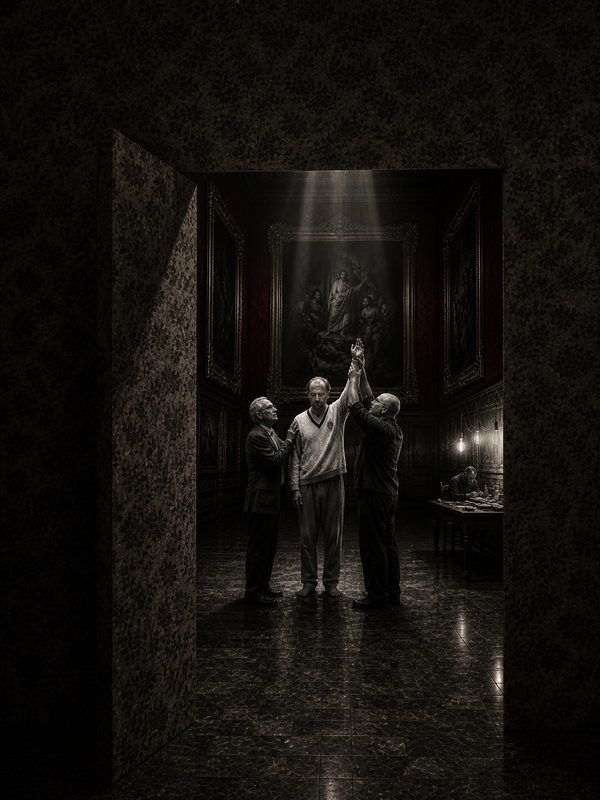
We turned from the counter. A few steps. Then a wall: covered in Renaissance ornament — dark botanical forms, interlacing scrollwork, the kind of pattern that holds the eye without resolving into meaning.

There was no door visible. No handle. No frame. No seam. The wall presented itself as complete, as final.

The old man found it anyway. He knew where the threshold was hidden within the pattern. He opened it — a door that could only be opened by someone who already knew where it was. It offered nothing to those who searched with ordinary eyes.

The numinosity arrived then. I did not know the word at the time, but I felt the thing itself: the floor of ordinary experience had given way, and something vast was present just below it. I was standing at an edge.

The ornamented wall

The wall that conceals what it contains.

The hidden threshold The moment of opening
A door that could only be opened by someone who already knew where it was. — III · The Hidden Door
IV · The Interior

The Sacred Chamber

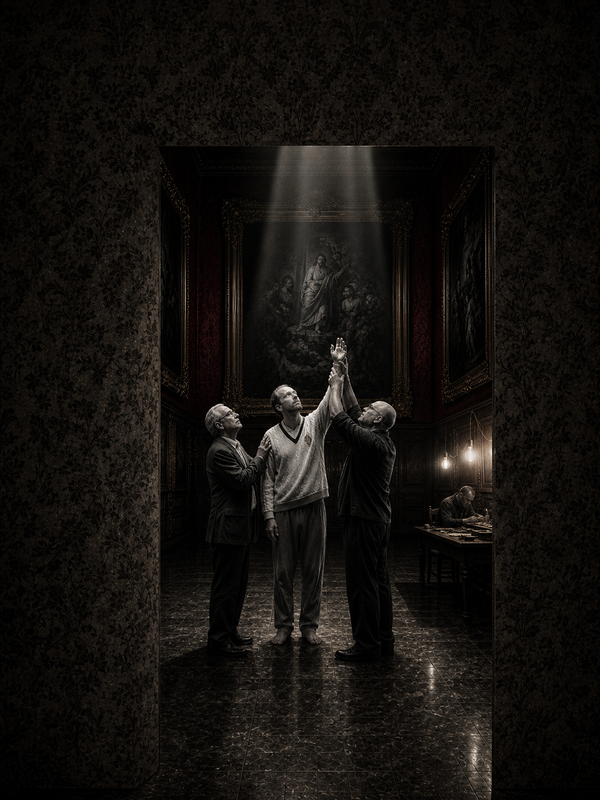
The room beyond was large — perhaps ten by ten metres, perhaps fifteen — but what defined it was the height. The ceiling rose beyond where lamplight reached. Along the walls, Renaissance frames held canvases: biblical subjects, or scenes from some older sacred vocabulary I could not fully read.

The room had the quality of an interior temple — a painter's atelier that had never been entered from outside, that existed only for those who came through the hidden door.

To the right of the entrance: a small table. Someone was seated there, or had just left. Beside the table, a lamp — and from it, bare wires protruded, their copper ends exposed. Even within the dream I noticed this with the attention of a craftsman: these wires need insulating — someone could be hurt. The practical thought in the middle of the numinous. The mundane detail that memory always keeps.

The chamber interior

The high-ceilinged room. The uncontained light.

Paintings on the wall The lamp with exposed wires

The sacred and the broken coexist. The light is present but dangerous.

V · Recognition

The Second Elder

The old man introduced me to a second figure. We greeted each other simply. His presence was quieter than the first — less a guide than a witness, a person at work with something that did not require explanation.

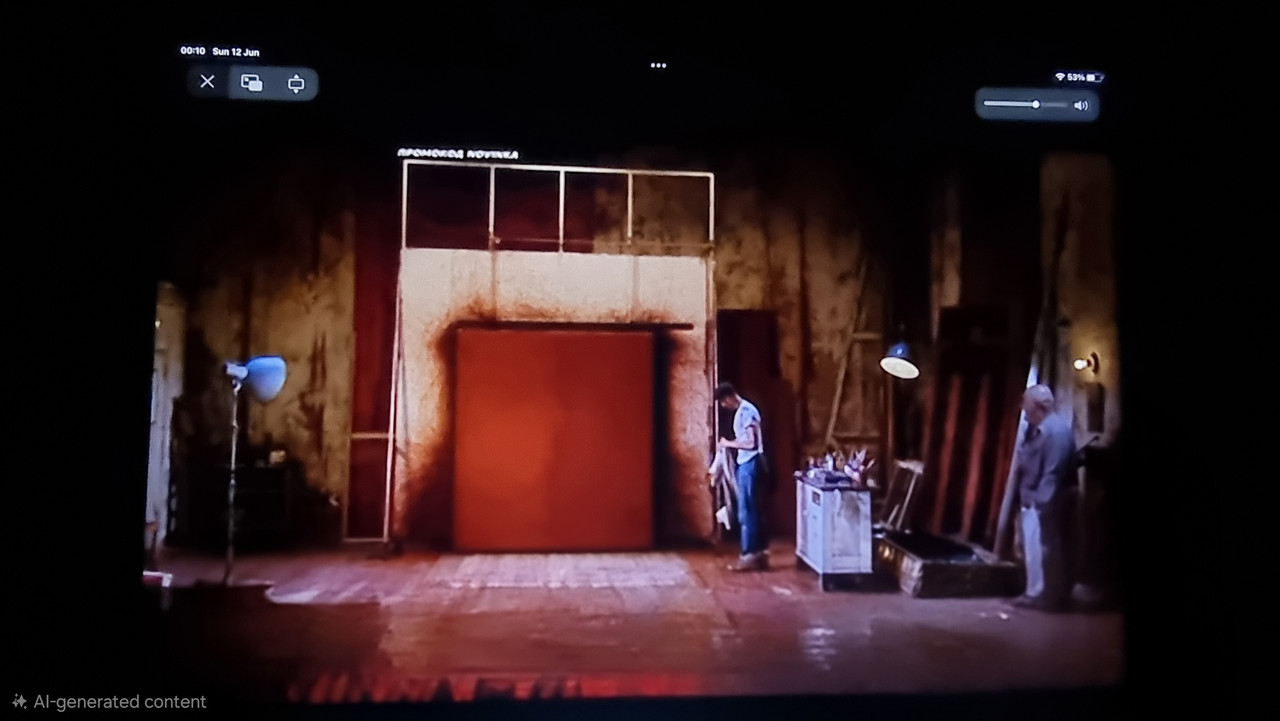
Only later — perhaps half a year after the dream — I saw the play Red, about Mark Rothko. The set disturbed me: a large studio, the table positioned to the right, a lamp. The same spatial logic. The same quality of interior darkness, of canvases as presences rather than pictures.

I understood then: the second figure may have been Rothko. Before this dream I had not known Rothko's face, had not read his interviews, had not seen his work in any sustained way. Before this dream I had not known that he was born approximately fifty kilometres from my own birthplace in Latvia. The proximity was not symbolic — it was geographical, biographical, a fact discovered after the image had already arrived.

The second elder in the studio
The studio atmosphere Canvases as presences
The meeting of the three

Dvinsk, Latvia. Fifty kilometres. Geography as symbol.

VI · The Central Act

That's her

· · ·

Then the central act.

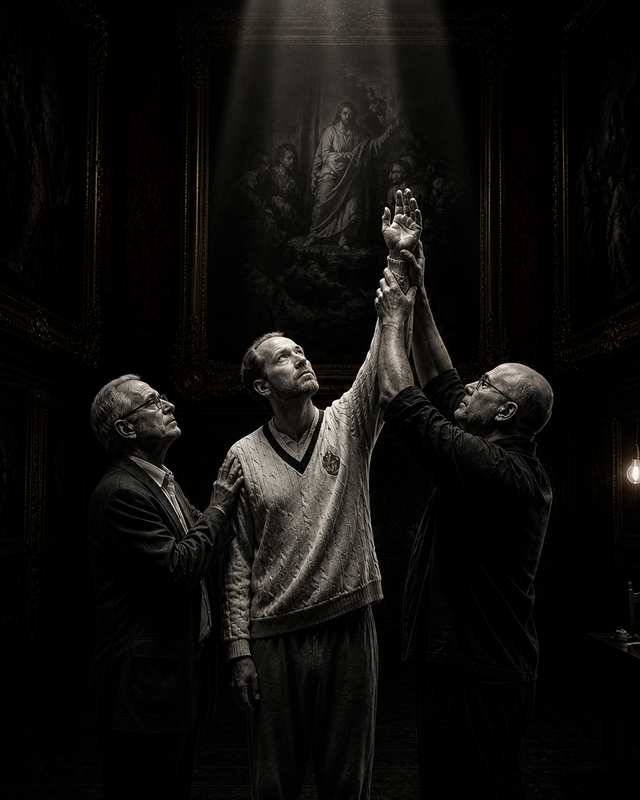
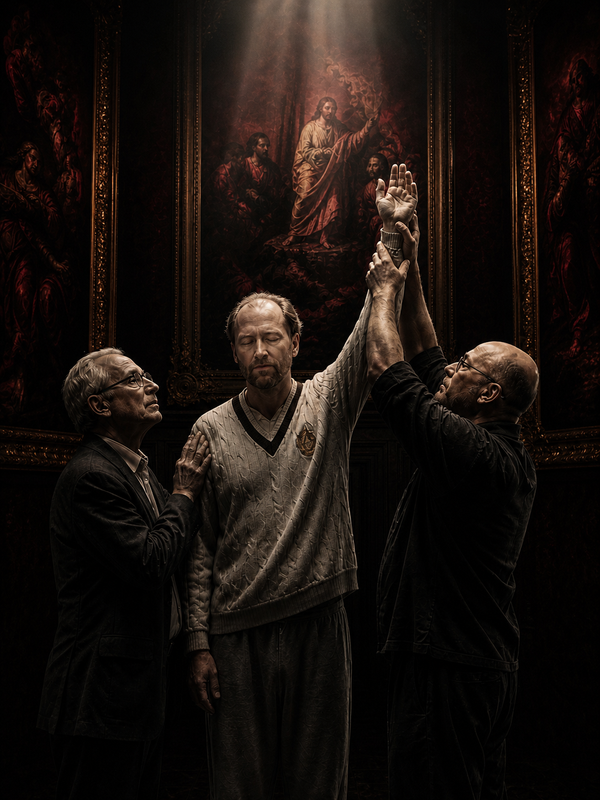
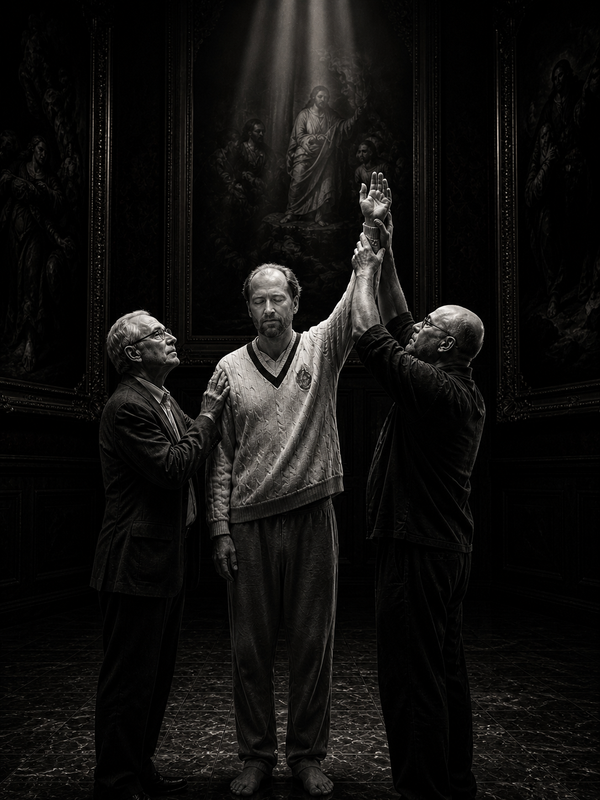
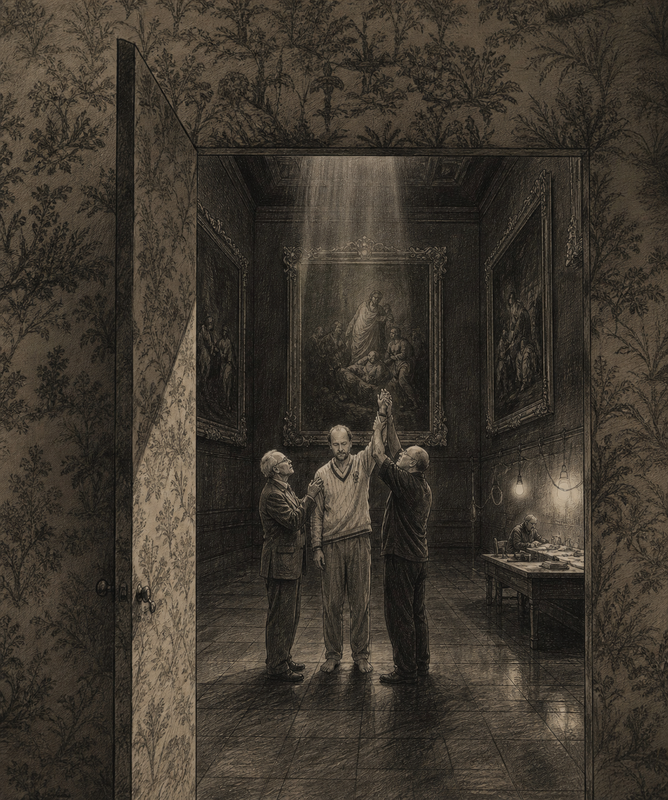
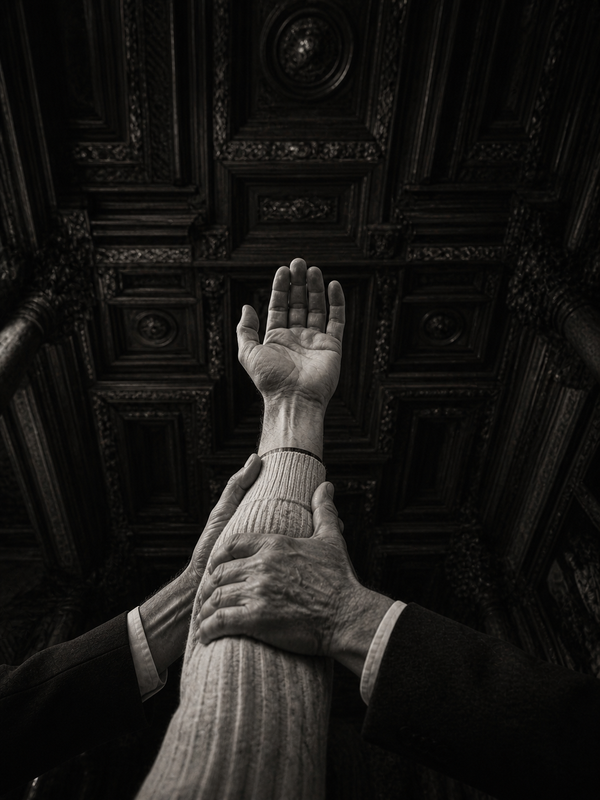
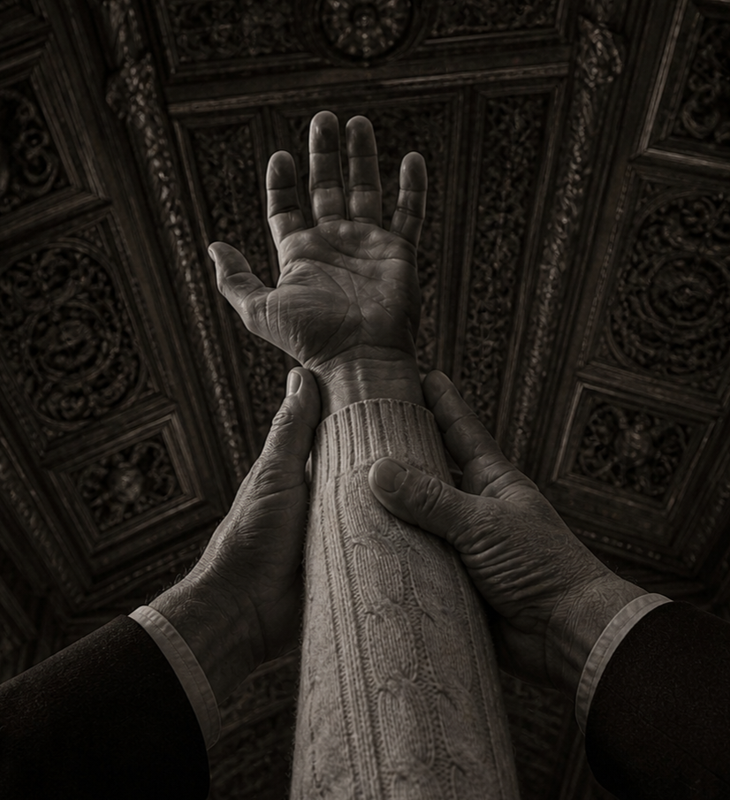
Both elders took my left hand. Together, they lifted it upward. And we began to turn — not chaotically, but around a shared axis, a deliberate rotation through the chamber. All three of us faced the raised hand. They examined it, speaking between themselves.

"That's her"

I asked: What do you mean — that's her?

But they were no longer attending to me as a person. Their attention had moved past me, to the hand itself — or to what the hand designated. They continued, calmly, with certainty, as though stating what had always been true and only now required stating.

What I felt then I can only describe as recognition from outside myself — not pride, not triumph, but a strange interior knowledge: something had been seen in me, or through me, that did not belong entirely to me. I had been marked — but the mark was not a possession. It pointed beyond.

The left side: the unconscious, the intuitive, the receiving. Important: I did not raise the hand myself. They raised it. The action originated not from the ego but from something larger, working through the figure assembled in that room.

I had been marked — but the mark was not a possession.
It pointed beyond. — VI · The Raised Hand
VII · The Sign

The Left Palm

The left hand remained the dream's central image in the ending — the dream ended in that rotation: two elders, the raised hand, the repeated phrase. Not a face. Not a name. A hand held up by two others, examined as though it were both instrument and text.

The left palm as organ of reception. As conductor of what passes through and does not originate here. As the site where something was recognised that exceeds the one who carries it.

The left palm -- the sign The left hand, raised

The left hand. Raised by others. The mark that points beyond.

Archive · After the Dream

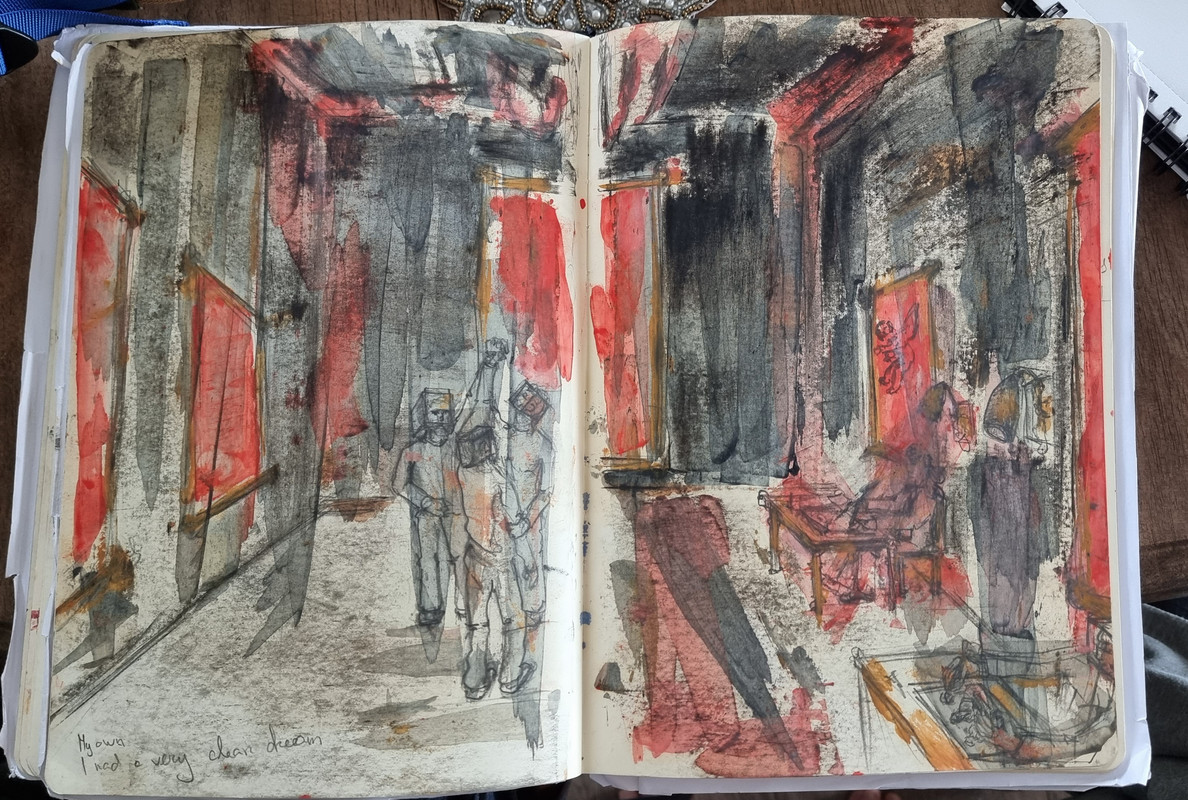
Dream sketch -- drawn at night, a month after the dream
Dream sketch · drawn at night, a month after the dream · in minutes, as if compelled
Red -- the play in which the studio from the dream was recognised
Red · the play in which the studio from the dream was recognised · the body went before the mind

A month after the dream, I woke in the night and drew what I had seen — in minutes, as if something had pushed me to capture it before it dissolved. Not a decision. A compulsion. Later, watching Red, I recognised the room: the table to the right, the lamp, the dense darkness, the canvases as presences. Not as resemblance — as identity.

Coda · After the Dream

When I woke, the world had altered in density. Not dramatically — no visions, no voices — but the pressure of reality had changed. As though the dream had not ended but had left a door open somewhere in the fabric of waking.

After this: the synchronicities intensified. A strong line appeared with a client from Riga. Then, gradually, the whole further path unfolded: Jung, Steiner, Rothko, Jaspers, Arendt, Tolstoy — philosophy, painting, the study of time and inner transformation.

The dream was not a conclusion. It was a beginning of movement that continues.

✦

Dublin · 2020 — 2021 · Spirit of Time Archive

  • Home
  • Beacons of Thought

    Beacons of Thought

    Twelve portals into the living archive, in three routes.

    All twelve portals →

    Lived coincidences

    Things that happened, written down as they came.

    • 01Gerard — The Returned MorningA voice, a face, and the first threshold of Spirit of Time.
    • 02The ThresholdA dream of two elders, a hidden door and the raised left hand.
    • 03Trembling on Dorset StreetA synchronicity narrative from Dublin.
    • 10The Place I Had Already FoundBeth, Hilma af Klint, a dream and the return to the Goetheanum.
    • 11Two LettersHow the name Virtuvian came.
    • 12Sleep Will Come26 November 2026, the day the book entered its own story.

    Essays on the threshold

    Thinking at the edge of the Noocene.

    • 04Transformation / ThreatWhen transformation carries danger.
    • 05From Anthropocene to NooceneOn the threshold of planetary consciousness.
    • 06The Syntax of Living MeaningMembrane intelligence and synthetic emergence.

    Maps of the archive

    Spatial models you can travel through.

    • 07The ConstellationThirty-two beacons in navigable deep space.
    • 08The CoreA spatial model of the living archive.
    • 09Semantic Map of MeaningA visual structure of symbolic relations.
  • Synchronicity
  • AI&I
  • Spirit of Time
    • The Noocene Virtue The Diamond Rule of Conscience
    • Figures of Time >
      • Rudolf Steiner & Joseph Beuys
      • Jaspers, Arendt, Rothko and the Boundary After Which One Cannot Return
  • The Work of Things
    • The Right of a Thing to Continue
  • Gallery
    • The Hidden Door
    • Three Works About Coicidence
    • Transformation/Threat
    • The Alchemy of Chanc
    • Jungian Space
    • Underwater Paradox
    • The Hidden Archetype
    • House for Sale
  • The Room
    • God in the paint
    • 8 May NOISE FACTORY
    • The Accumulated Debt of Geography
    • Victory as Aliby
    • Heir by Direct Line
    • The Human Material of Evil
    • The Structure of Evil as System
  • Contact