CHRONICLER / THE PART OF VISUAL ART, INTUITION IS MY GUIDE FOR UNDERSTANDING BEYOND THE OBSERVABLE WORLD EALOIONTOIR/ARCHI/AIVAR DRUKALSKI
  • Home
  • Beacons of Thought

    Beacons of Thought

    Twelve portals into the living archive, in three routes.

    All twelve portals →

    Lived coincidences

    Things that happened, written down as they came.

    • 01Gerard — The Returned MorningA voice, a face, and the first threshold of Spirit of Time.
    • 02The ThresholdA dream of two elders, a hidden door and the raised left hand.
    • 03Trembling on Dorset StreetA synchronicity narrative from Dublin.
    • 10The Place I Had Already FoundBeth, Hilma af Klint, a dream and the return to the Goetheanum.
    • 11Two LettersHow the name Virtuvian came.
    • 12Sleep Will Come26 November 2026, the day the book entered its own story.

    Essays on the threshold

    Thinking at the edge of the Noocene.

    • 04Transformation / ThreatWhen transformation carries danger.
    • 05From Anthropocene to NooceneOn the threshold of planetary consciousness.
    • 06The Syntax of Living MeaningMembrane intelligence and synthetic emergence.

    Maps of the archive

    Spatial models you can travel through.

    • 07The ConstellationThirty-two beacons in navigable deep space.
    • 08The CoreA spatial model of the living archive.
    • 09Semantic Map of MeaningA visual structure of symbolic relations.
  • Synchronicity
  • AI&I
  • Spirit of Time
    • The Noocene Virtue The Diamond Rule of Conscience
    • Figures of Time >
      • Rudolf Steiner & Joseph Beuys
      • Jaspers, Arendt, Rothko and the Boundary After Which One Cannot Return
  • The Work of Things
    • The Right of a Thing to Continue
  • Gallery
    • The Hidden Door
    • Three Works About Coicidence
    • Transformation/Threat
    • The Alchemy of Chanc
    • Jungian Space
    • Underwater Paradox
    • The Hidden Archetype
    • House for Sale
  • The Room
    • God in the paint
    • 8 May NOISE FACTORY
    • The Accumulated Debt of Geography
    • Victory as Aliby
    • Heir by Direct Line
    • The Human Material of Evil
    • The Structure of Evil as System
  • Contact
Transformation / Threat — Ealoiontoir Archive
← Beacons of Thought Ealoiontoir · The Spirit of Time

Ealoiontoir Archive · The Codex

Transformation/Threat

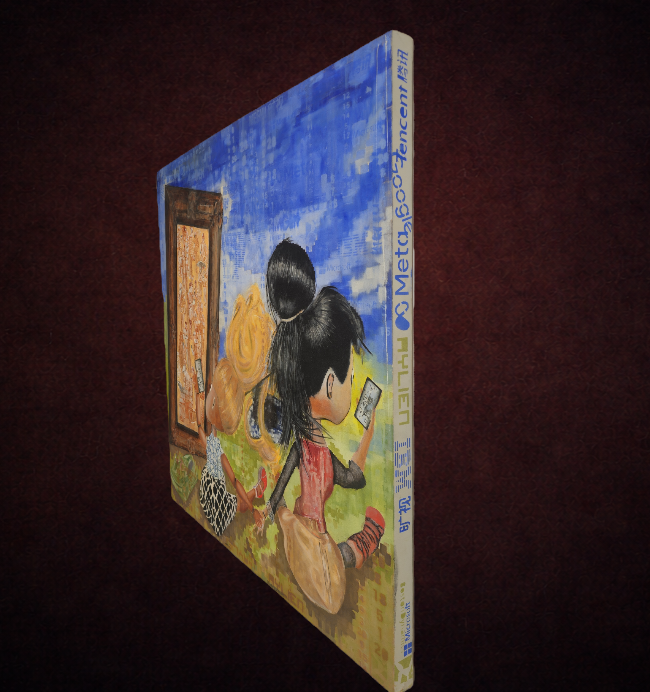
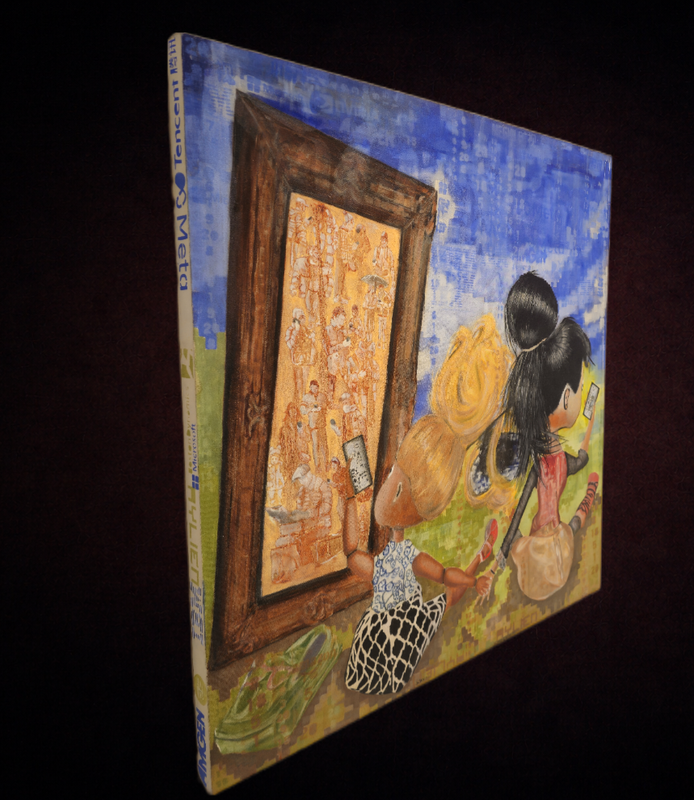
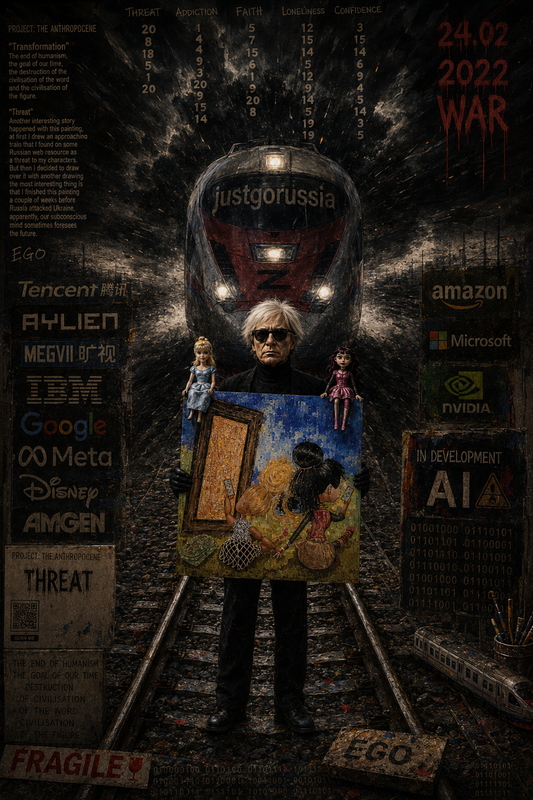
A painting as archive of the digital anthropocene

Oil on canvas · 110 × 110 cm · NCAD Dublin · Fine Art · The Anthropocene Project · 2021–2022

Transformation / Threat -- oil on canvas 110×110 cm

"Before I knew the name of the force, I painted its pressure."

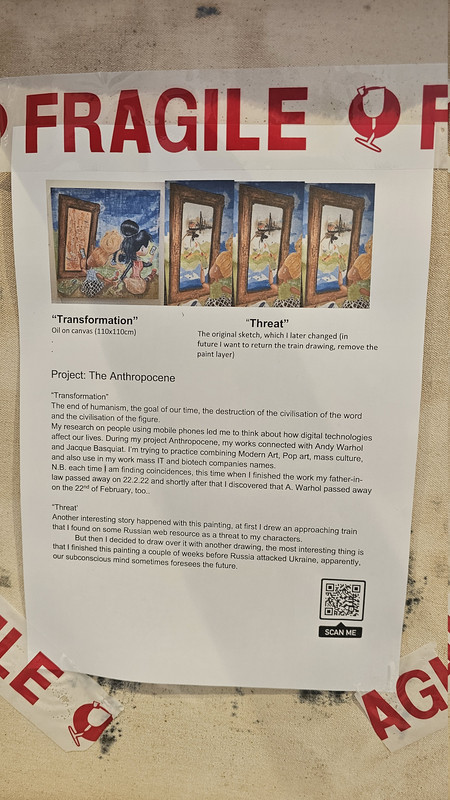
The painting was completed around 20 February 2022.

Two days later, my stepfather died.

On the same date, but in 1987, Andy Warhol died.

Some weeks earlier, I had painted over a train drawn in the first layer.

Two days after that — the war began.

This is not art criticism. Art criticism explains a painting through style, school, influence, market, historical context. The task here is different: to follow the painting from its first impulse to the layers of meaning that revealed themselves later. To follow honestly — without embellishment, without explaining quickly what does not yield to quick explanation.

The work was called Transformation. Then a second name appeared alongside it: Threat. In the archive it lives as a double name. This doubling was not accidental. The painting does not choose one pole. It holds both simultaneously.

It speaks of transformation — but within that transformation, threat is already present. It speaks of threat — but that threat itself becomes the beginning of a new form.
The Hidden Layer

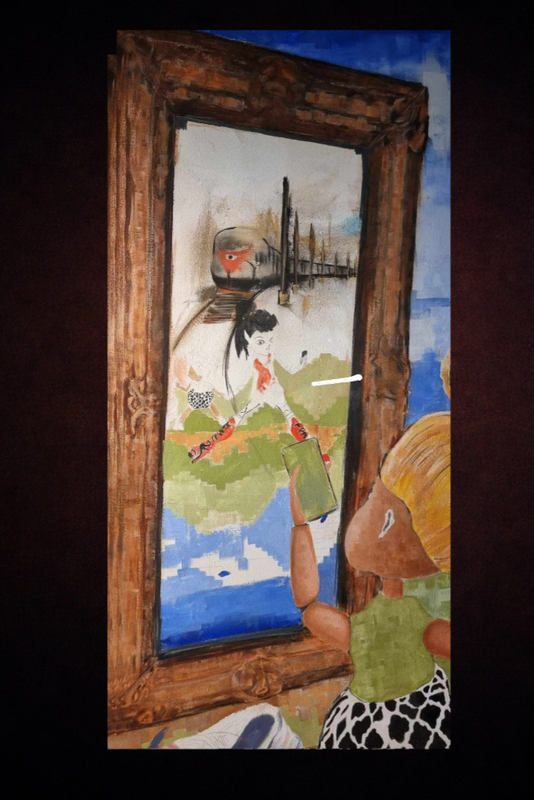
The Train Under the Paint

Before the final image existed, there was another. A train. Moving toward dolls sitting on the rails, absorbed in their phones.

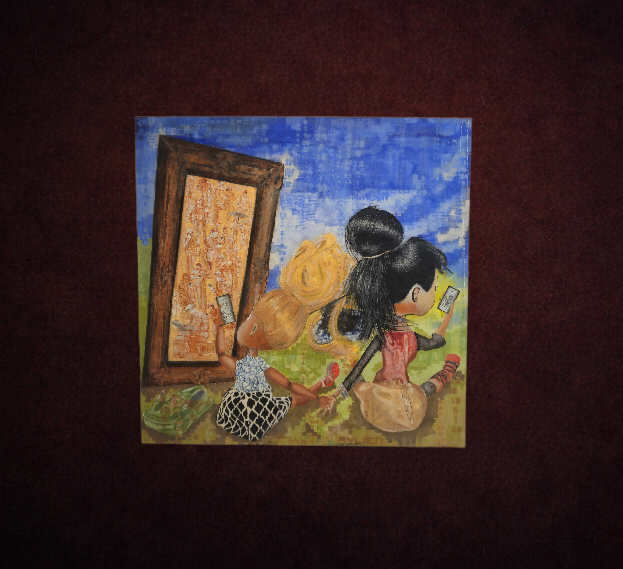
Final painting layer -- Transformation / Threat
Visible Layer
Final painting · February 2022
Hidden Sapsan train sketch -- first layer
Hidden Layer
Sapsan sketch · first layer · painted over

"The train was there. Then it was covered.
Then the world caught up with the image."

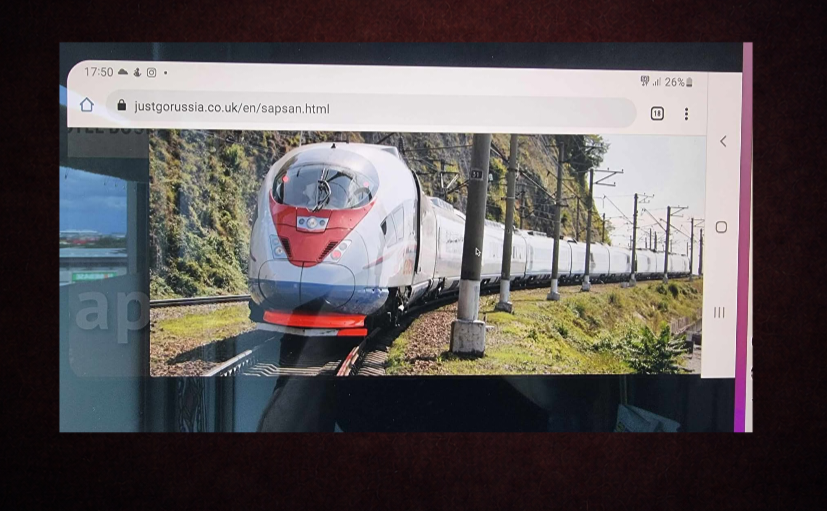
The image of the train was taken from the Russian tourist site justgorussia.co.uk/en/sapsan.html — the Sapsan high-speed locomotive, moving directly toward dolls sitting on the rails, absorbed in their phones. A screenshot of the source page is preserved in the archive.

At a certain point I felt bodily anxiety — not an intellectual decision, not aesthetic doubt. Something like the sense of blood inside the image. Something too direct, too dangerous in its visibility. I painted over the train.

The covered layer was not destroyed. It became archival. What is covered sometimes acts more powerfully than what is visible — because it begins to work from inside the surface.

On 24 February 2022, Russia launched the full-scale invasion of Ukraine. After that day, the first layer of this painting could no longer be read the same way.

The painting did not predict the war. It registered a pressure before I knew its name.

Screenshot of justgorussia.co.uk Sapsan source
Archive · source screenshot · justgorussia.co.uk/en/sapsan.html
The Painting

Dolls Before a Mirror

The final painting shows two dolls before a mirror. Draculaura and Cinderella. Dark and light. The doll of night, gothic imagery, blood, vampiric form. The doll of fairy tale, fragility, transformation, the glass slipper. Both absorbed in phones. Both looking at screens rather than at the world.

In the mirror are people. Not invented figures — these were life sketches made in central Dublin. Real people on the city streets, in everyday life, absorbed in phones. The dolls look into screens. The people in the reflection are also absorbed in screens.

The question the painting poses but does not answer: who reflects whom? Are the dolls reflecting people, or are people reflecting dolls? Or has the digital world already made both part of a single system of attention?

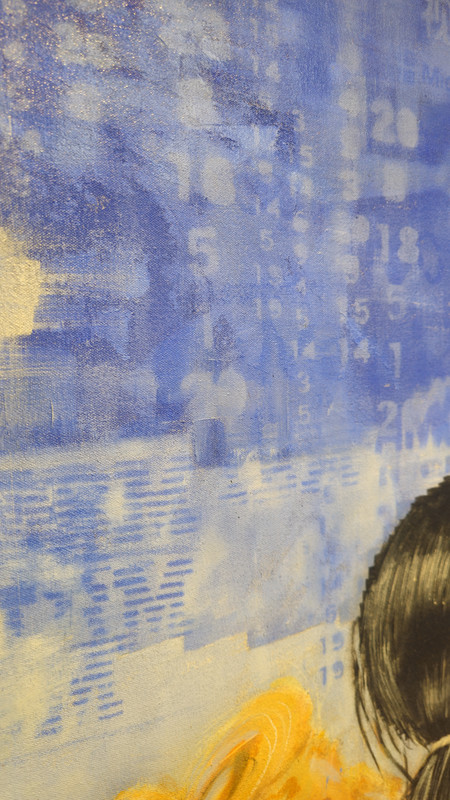
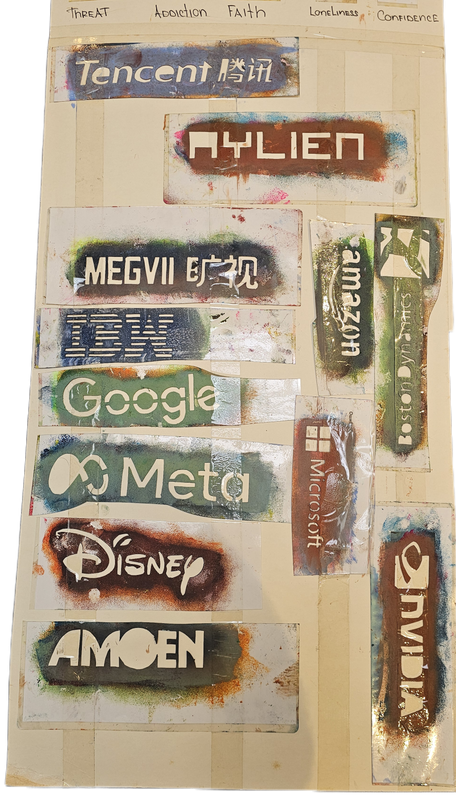
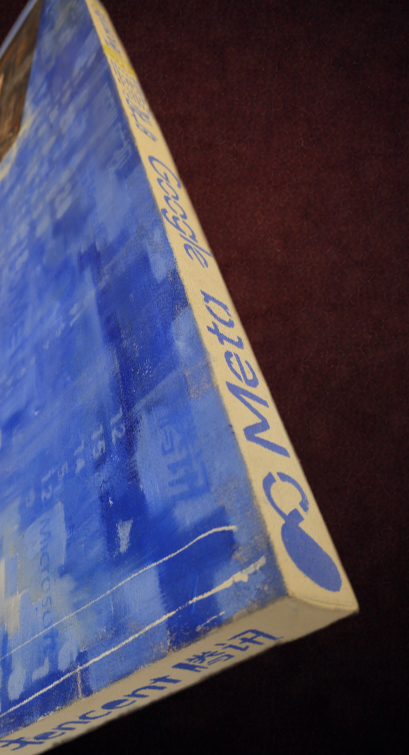
Along the edges of the canvas, the names of companies appear: Tencent, Meta, Google, Disney, Microsoft, NVIDIA, and others. They are not labels — they are the walls of the room. The context that formed before the figures arrived inside it. The infrastructure of the world that surrounds this scene.

Transformation painting detail
Transformation painting in studio
Archive Cipher

Six Words, Encoded

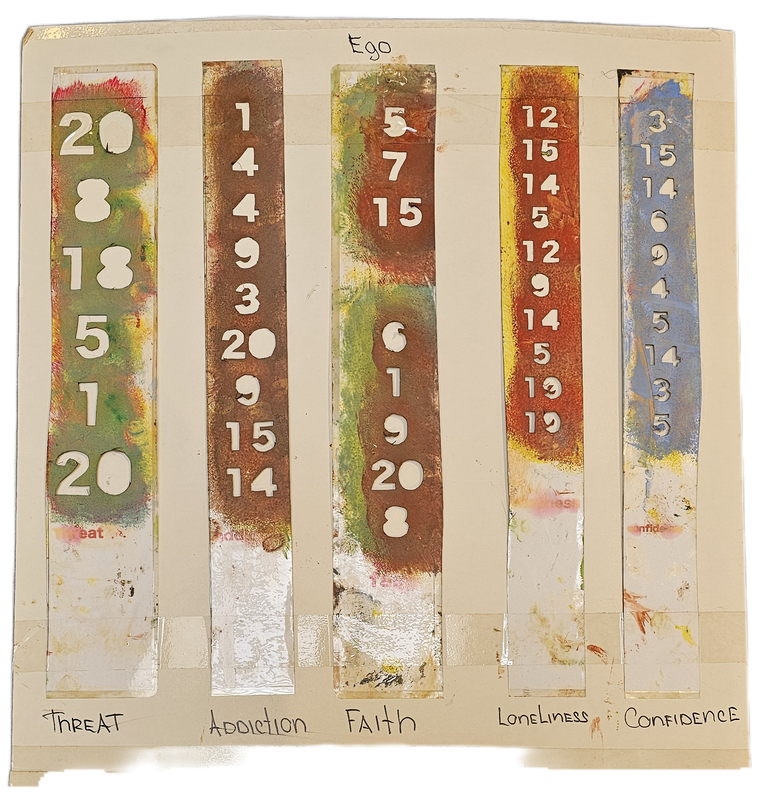
Into the painting, six words were embedded — not as visible text, but as numerical code. Columns of numbers. Human states translated into digital form. The gesture itself was the message: what we feel, translated into the language machines speak.

05 07 15
Ego
Above all the others. The condition under which all other words exist. Threat exists for the ego. Addiction grasps at the ego. Faith either saves it or becomes its mask.
20 08 18 05 01 20
Threat
The force that arrives before it can be named.
01 04 04 09 03
Addiction
What disguises itself as freedom.
06 01 09 20 08
Faith
Or its absence. The question the screen cannot answer.
12 15 14 05
Loneliness
The ego sealed within itself. Growing inside constant connection.
03 15 13 13
Communication
The attempt to exit isolation. Or its simulation.
Encoded words archive sheet
Archive · encoded words sheet · original working document
The Outer Frame

Corporate Infrastructure

Along the edges of the canvas — the names of companies. Not as critique, not as slogan, but as the physical boundary of the world the dolls inhabit. They were there before the figures arrived. They are the walls of the room.

Companies sheet archive
Archive · companies sheet · original working document
Synchronicity I

Drella — The Hand Knew First

Doll I Draculaura
+
Doll II Cinderella
↓
DRELLA
Andy Warhol's secret name · given by Lou Reed

Andy Warhol had a nickname. It was given to him by Lou Reed — the musician close to the Factory. The nickname was Drella, a compound of two words: Dracula and Cinderella.

I went to my daughter's room and took these two specific dolls — Draculaura and Cinderella — to paint them in a work made in the direct context of studying Warhol. I did not know this connection. The hand moved before the mind could explain it.

When the connection was discovered, the experience was not intellectual. It was bodily: a physical discharge, a recognition rather than a conclusion. The body understood before the mind had words for it. The image existed before the knowledge.

Warhol worked with simulacra — Campbell's Soup, Marilyn, Mao — with cold distance, multiplication without inner warmth. His work had once left me with a sense of emptiness. But in this painting, a similar movement occurred, only from the inside. The dolls are also simulacra: Cinderella is an industrial fairy tale; Draculaura is industrial gothic. The phone is a simulacrum of communication. The mirror is a simulacrum of encounter.

The difference was position. Warhol stood outside his material. I found myself inside.

Synchronicity II

22 February

22.02
1987
Andy Warhol died
35 years
between
2022
My stepfather died

The painting was completed two days earlier. Warhol is already present in the work — invisibly, through Drella.

Synchronicity II · The Date
The painting completed. Two deaths. One date. Thirty-five years apart.

Rudolf Otto called it the numinosum — not simply a strong feeling, but the experience of a meaning exceeding immediate explanation. Not ecstasy. Not fear. Rather a discharge. Contact with something that does not fit the ordinary order of cause and effect.

Jung defined synchronicity as a meaningful coincidence: an external fact and an internal state connecting without visible causal link. Not the supernatural — but an event that would be dishonest to ignore.

This convergence is not explained. It is documented.

Synchronicity III · The Train
24 February 2022 — The World Caught Up

The first layer with the Russian train was painted over before 24 February. After the war began, that layer could not be read the same way. The image of threat existed before the event. The layer was covered before the event. After the event, it opened differently.

"The train was there. Then it was covered. Then the world caught up with the image."

There is a physical fact here that separates this from retrospective construction: the train under the paint exists as a material reality. The source screenshot is preserved. This is archival evidence, not interpretation added after.

Archive Map

Constellation of Nodes

Hover or tap each node to reveal its place in the archive.

Archive

Chronological Record

Autumn 2021
Dream. Structural threshold.
A dream that would later become part of the text "Eto ona." The interior state shifts.
November 2021
Dorset Street. A synchronicity with a client from Riga.
An encounter after twenty-five years. The pattern of meaningful coincidence begins to clarify.
Winter 2021–2022
NCAD, Dublin. The Anthropocene project begins.
Studying Warhol, Basquiat, pop art. The question of the digital world as threat to the human and to the artist.
Winter 2021–2022
Phone call with a colleague. Advice to watch Red — deferred.
She confirms the Dorset Street encounter. She recommends the Rothko play. The advice is not taken yet.
Winter 2022
First layer: the Sapsan train.
Image sourced from justgorussia.co.uk/en/sapsan.html. The locomotive moves toward the dolls on the rails.
Early February 2022
The train is painted over.
A bodily anxiety — not intellectual analysis. The image felt too direct, too dangerous in its visibility.
Around 20 February 2022
The painting is completed.
Final layer: two dolls before a mirror. Six words encoded in numbers. Company names on the edges.
22 February 2022
My stepfather dies.
Later discovered: Andy Warhol died on 22 February 1987. Thirty-five years apart. One date.
After completion
Discovery: Warhol's nickname was Drella.
Dracula + Cinderella. The hand had chosen the dolls before the mind knew the connection.
24 February 2022
Russia begins the full-scale invasion of Ukraine.
The covered Russian train acquires a new historical dimension. The archive preserves the sequence.
July 2022
MidJourney. Artistic recognition of a digital tool.
Not fear, not rejection — an encounter with a new medium for visual thinking.
Autumn 2022
Watching Red. Bodily recognition of the studio from the 2021 dream.
Rothko enters. The dialogue about Warhol overtaking Rothko, as Rothko had overtaken Kandinsky, becomes personal.
Late 2022
ChatGPT. The Codex begins.
The digital world that the painting registered as threat becomes the instrument through which the archive learns to speak.
2022–2026
The Codex. Synchronistic maps. Spirit of Time.
The painting as origin point of a larger archive.
May 2026
This archive page.
Four years after completion. The painting continues to open.
Later Node

Rothko — The Studio from the Dream

During or around the work on this painting, a phone call took place with a colleague. I was telling her the story of the Dorset Street synchronicity — the client from Riga, Dublin, the encounter after twenty-five years. She confirmed she recognised the person. And almost in passing, she suggested I watch Red — the play about Mark Rothko.

I did not watch it then. Rothko was not yet mine. Something about him felt too institutional, too ceremonial. I was occupied with Warhol.

Some months later — after having passed through Warhol in this painting — I watched Red. In it, a dialogue about the succession of epochs: Warhol overtaking Rothko, as Rothko had overtaken Kandinsky. One artistic language displacing another. This spoke directly to me only because I had already been through Warhol from the inside.

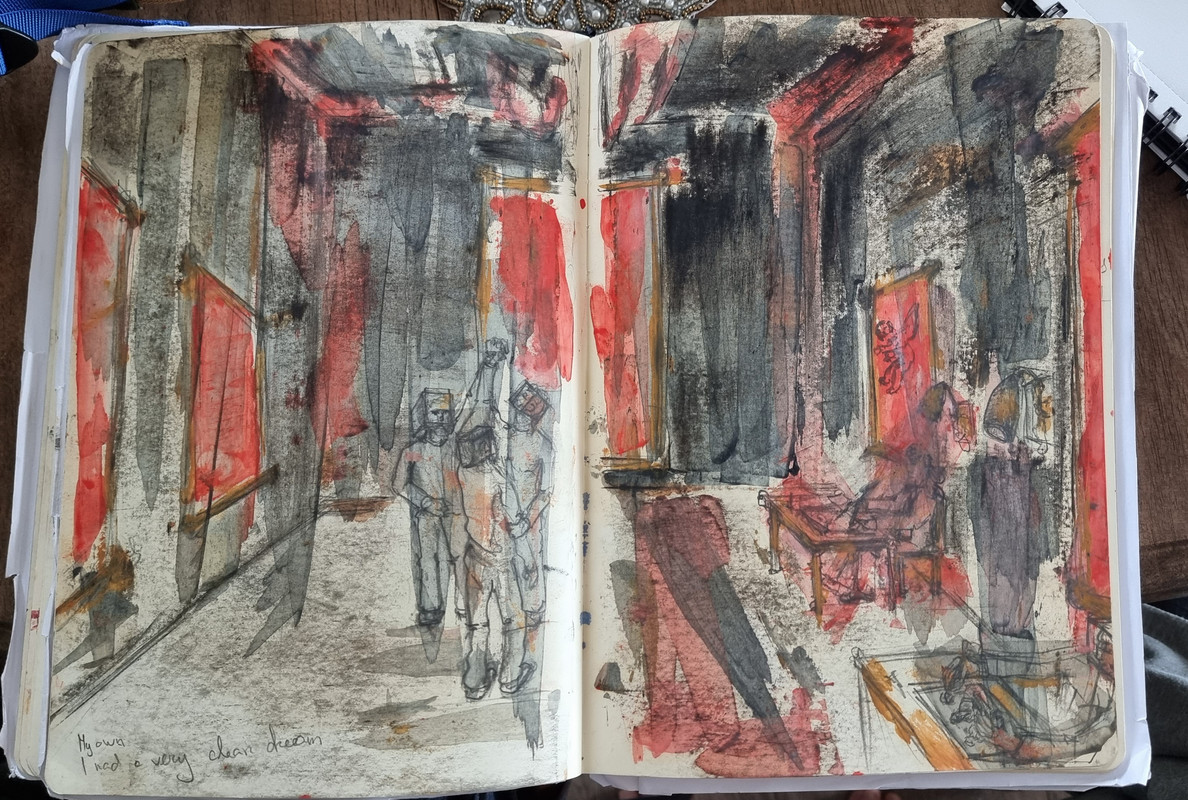
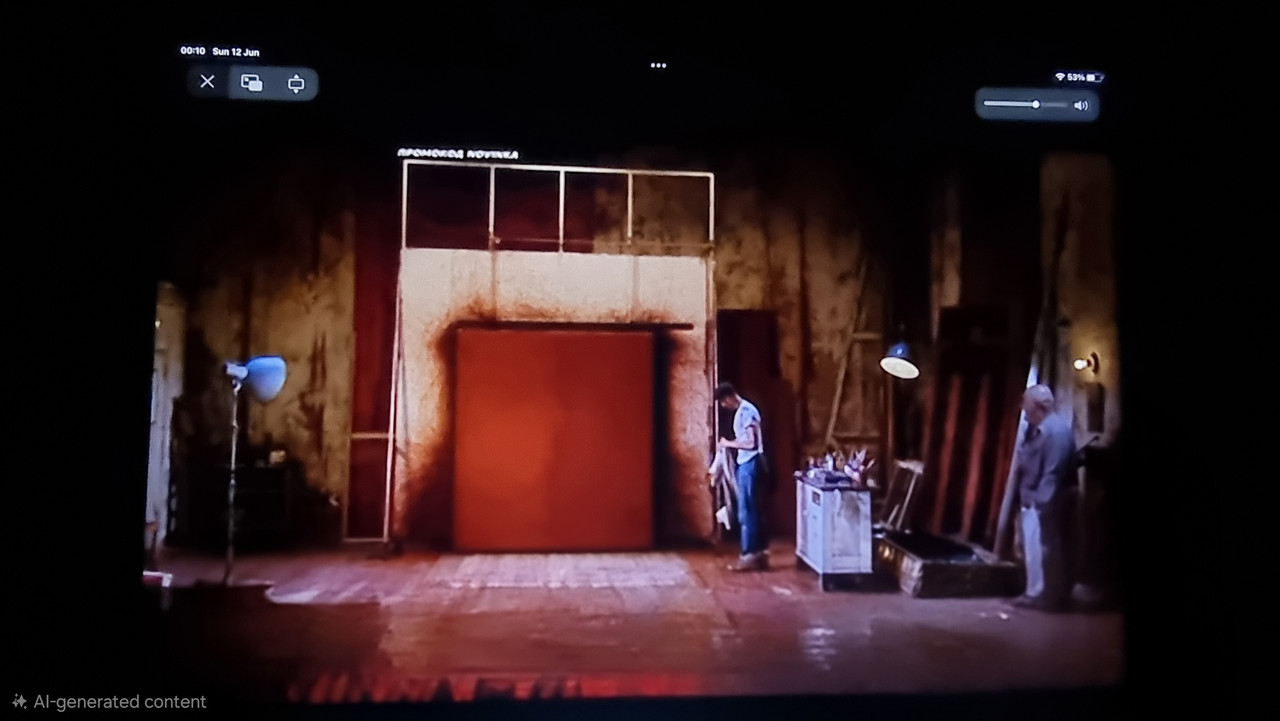
But the main event was not the text. It was the space. In Red, Rothko's studio was recreated: a dark room, a table to the right, a lamp, a dense and almost material darkness, paintings as presences rather than objects. I recognised that room. Not with the mind — with the body. The physical discharge of numinous recognition. It was the room from the 2021 dream.

Dream sketch -- drawn at night, a month after the dream
Archive · Dream sketch · drawn at night, a month after the dream · in minutes, as if compelled
→ Read the full story of this dream: The Threshold
Red -- the film in which the studio from the dream was recognised
Archive · Red · the film in which the dream studio was recognised

The dream came first. A month passed. Then I woke in the night — and in minutes, as if something had pushed me to capture it before it dissolved, I reconstructed the dream with rapid expressive marks. Not a decision. A compulsion. I drew what I had seen. Later, watching Red, I recognised that room. Not as resemblance — as identity. The body went before the mind.

Only then did the figure from the dream and Rothko converge — not through reasoning, but through bodily recognition that preceded any word. Later still: a curator at NCAD, learning I was from Latvia, asked whether I knew Rothko. He was born in Dvinsk — present-day Daugavpils — close to the places connected to my own roots.

Three events in different times. All about the same thing. The body understood each time before the mind could form the sentence.

Threshold

The Digital World Crosses Over

First, I painted the digital world as external threat.

Then that same world became the instrument through which the archive learned to speak.

The duality does not resolve. Both remain true simultaneously.

When this painting was made, I was not deeply embedded in technology. I used it but did not live inside it as a natural environment. The digital world and I were on formal terms. Which makes it stranger that the painting so insistently entered this territory: phones, codes, logos, robotics, digital dependency, technological pressure, the ecology of attention.

In 2021–early 2022, artificial intelligence was not yet the mass cultural face of the digital era. MidJourney and ChatGPT had not yet entered everyday culture. The subject of the painting was the digital world in its broader form: screens, IT companies, robotics, Boston Dynamics, the new architecture of human attention.

In July 2022, I began using MidJourney almost immediately after its appearance. The reaction was unexpected: not rejection, not fear, but artistic recognition. A tool for visual thinking that reached places the hand could not. Then ChatGPT. From there, the Codex began to form: dialogues, archive, analysis, synchronistic maps, Spirit of Time.

The painting stood at the threshold of the digital anthropocene before AI became its public face. It registered a pressure before the pressure had a later name.

Archive

Archive Gallery

Transformation / Threat -- full painting
Transformation / Threat · Oil on canvas 110×110 cm
Painting detail
Painting · detail
FRAGILE -- archive description sheet
FRAGILE · Archive description sheet
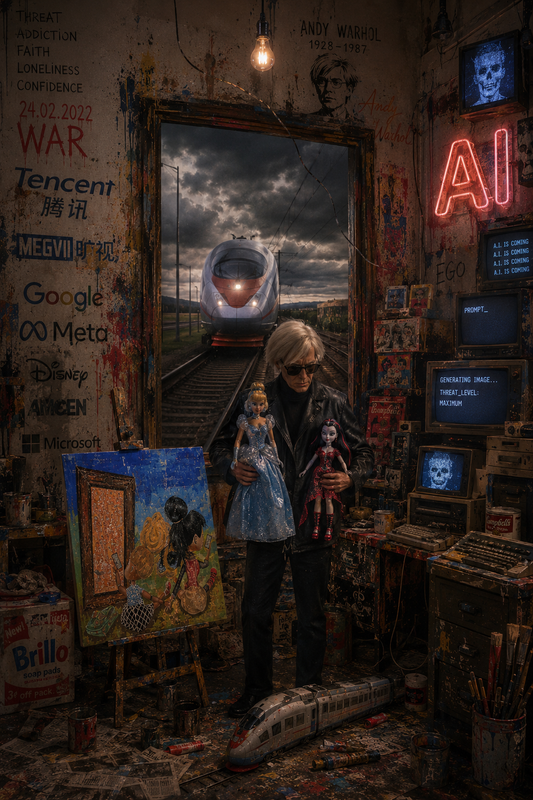
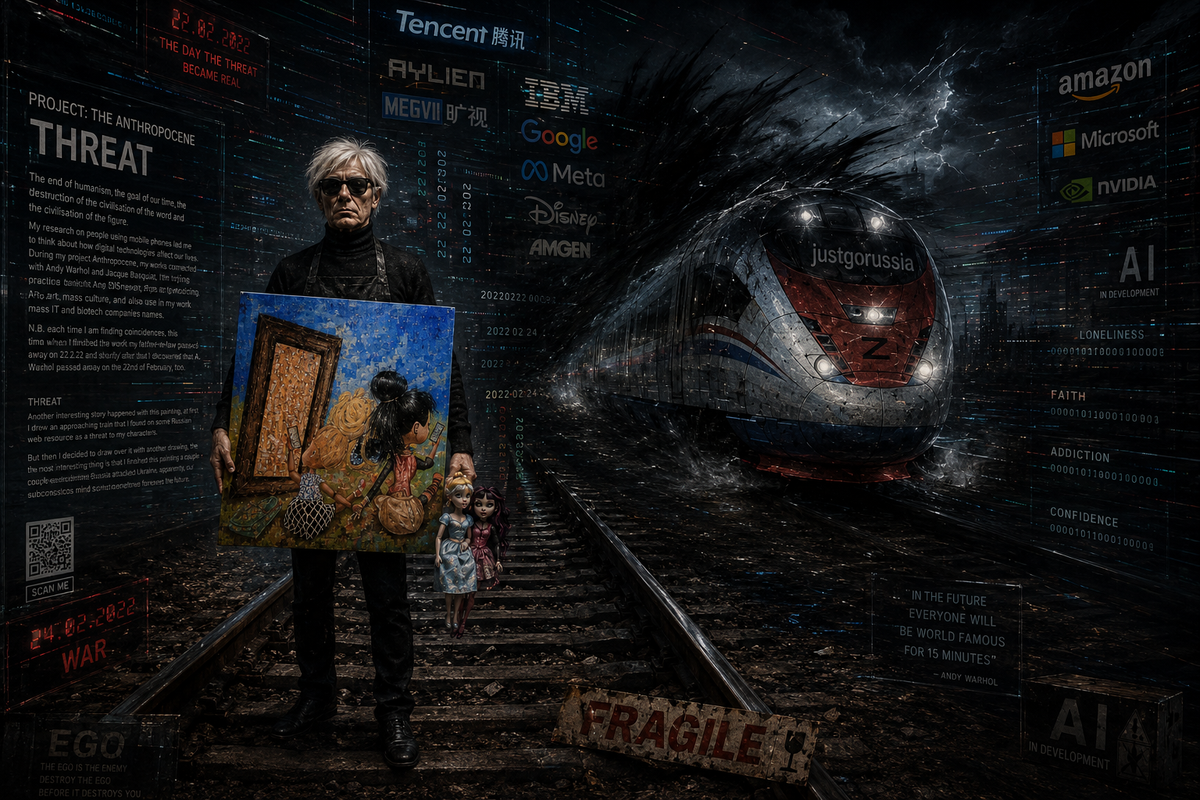
Generated visualisation
Contextual visualisation
Generated visualisation -- Warhol context
Warhol / archive visualisation
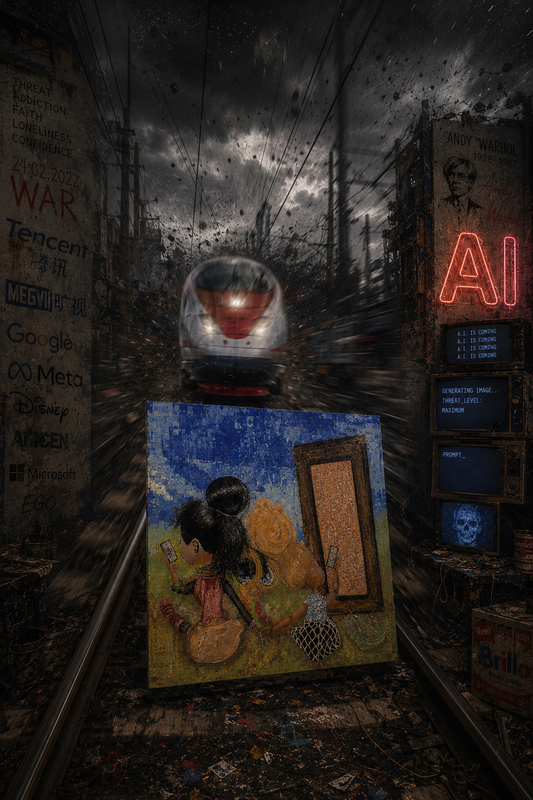
Story visualisation
Story visualisation
Context visualisation
Full context visualisation
Film Archive

Video Documents

Two visual narratives documenting this story.

Archive Video I · Transformation / Threat — visual narrative I
If the video does not load: open in Google Drive →
Archive Video II · Transformation / Threat — visual narrative II
If the video does not load: open in Google Drive →
The Archive Remains Open

Unresolved

Why does anxiety speak through the body — before the mind has formed the question?
Where is the boundary between synchronistic recognition and retrospective construction of meaning?
What does the train under the paint mean — and should that layer ever be uncovered?
If the digital world was first threat, and then became instrument — what is threat, essentially? Is it always that which has not yet been inhabited from the inside?
Is the Codex an answer to the painting's question, or a continuation of that question by other means?
The painting remained not as answer, but as a detection instrument. It did not explain the time. It showed that the time had already entered the image before I was able to understand it.

"The digital world first appeared as threat.
Later it became the instrument through which the archive could speak.
The duality does not resolve.
Both names remain true."

Dublin, May 2026 · From the archive of the Codex

Where reconstruction — it is marked. Where uncertainty — it is not hidden.

Ealoiontoir
The Spirit of Time · Archive · Codex
← Back to Beacons of Thought
  • Home
  • Beacons of Thought

    Beacons of Thought

    Twelve portals into the living archive, in three routes.

    All twelve portals →

    Lived coincidences

    Things that happened, written down as they came.

    • 01Gerard — The Returned MorningA voice, a face, and the first threshold of Spirit of Time.
    • 02The ThresholdA dream of two elders, a hidden door and the raised left hand.
    • 03Trembling on Dorset StreetA synchronicity narrative from Dublin.
    • 10The Place I Had Already FoundBeth, Hilma af Klint, a dream and the return to the Goetheanum.
    • 11Two LettersHow the name Virtuvian came.
    • 12Sleep Will Come26 November 2026, the day the book entered its own story.

    Essays on the threshold

    Thinking at the edge of the Noocene.

    • 04Transformation / ThreatWhen transformation carries danger.
    • 05From Anthropocene to NooceneOn the threshold of planetary consciousness.
    • 06The Syntax of Living MeaningMembrane intelligence and synthetic emergence.

    Maps of the archive

    Spatial models you can travel through.

    • 07The ConstellationThirty-two beacons in navigable deep space.
    • 08The CoreA spatial model of the living archive.
    • 09Semantic Map of MeaningA visual structure of symbolic relations.
  • Synchronicity
  • AI&I
  • Spirit of Time
    • The Noocene Virtue The Diamond Rule of Conscience
    • Figures of Time >
      • Rudolf Steiner & Joseph Beuys
      • Jaspers, Arendt, Rothko and the Boundary After Which One Cannot Return
  • The Work of Things
    • The Right of a Thing to Continue
  • Gallery
    • The Hidden Door
    • Three Works About Coicidence
    • Transformation/Threat
    • The Alchemy of Chanc
    • Jungian Space
    • Underwater Paradox
    • The Hidden Archetype
    • House for Sale
  • The Room
    • God in the paint
    • 8 May NOISE FACTORY
    • The Accumulated Debt of Geography
    • Victory as Aliby
    • Heir by Direct Line
    • The Human Material of Evil
    • The Structure of Evil as System
  • Contact